Wide Calf Travelers: Reduce Swelling After Flying Within Hours
The fastest way to reduce swelling after flying is to get moving the second you’re allowed to, elevate your legs above heart level, loosen anything tight around your ankles, and wear graduated compression sized for your actual calf, not a generic small/medium/large chart. Most swelling from a flight fades within a few hours to a day. If it’s only in one leg, painful, or still there after 24 hours, stop reading remedies and call a doctor.
TL;DR:
- Swelling greater than 24 hours, unilateral, painful, or accompanied by skin discoloration requires immediate medical attention.
- Sitting still during flights impairs calf muscle pumps, which are essential for preventing fluid pooling in the lower legs.
- In studies of long-haul flyers, graduated compression stockings (15–30 mmHg) were linked to less leg swelling (Cochrane review).
- Elevating legs, walking promptly after landing, and massaging toward the heart significantly speed up the reduction of post-flight swelling.
- Wide-calf compression socks made from breathable bamboo provide better fit and comfort for long flights, with a 60-day guarantee to ensure proper sizing.
Table of Contents
- Why Do Your Legs and Feet Swell After Flying?
- What Can You Do During the Flight to Prevent Swelling?
- What Reduces Puffy Legs Fast After You Land?
- Do Compression Socks Actually Reduce Swelling on Flights?
- When Is Leg Swelling After Flying a Warning Sign?
- A Word From Movira on Fit and Long-Haul Comfort
- Travel Socks Built for Calves Standard Sizing Ignores
- Sources
- FAQ
Why Do Your Legs and Feet Swell After Flying?
Sitting still for hours is the real culprit, not cabin pressure. Your calf muscles normally act as a pump, squeezing the veins in your lower legs and pushing blood back up toward your heart. When you sit for three, five, or twelve hours without moving, that pump barely fires. Fluid pools in your feet and ankles simply because gravity wins. Doctors call this dependent edema, and it’s the same reason your feet swell after a long car ride or a day standing at a cash register.

Cabin pressure and low humidity get blamed a lot, but Mayo Clinic notes that swelling during air travel is common and usually comes from prolonged sitting, not the altitude itself. Those factors play a smaller supporting role.
Some travelers notice it more than others. You’re more likely to see pronounced swelling if you’re over 50, carrying extra weight, pregnant, recovering from recent surgery, or taking certain medications like hormone therapy or some blood pressure drugs. None of that means something is wrong. It just means your body needs a little more help doing what gravity is working against.
What Can You Do During the Flight to Prevent Swelling?
Prevention beats treatment here, and most of it takes less effort than scrolling your phone. The CDC recommends frequent movement and calf exercises for anyone on a long flight, and travel health experts suggest activating your leg muscles roughly every 15 to 20 minutes.
Try this simple in-seat routine:
- Ankle pumps: point your toes down, then flex them up toward your shins. Do 15 reps.
- Heel raises: lift your heels off the floor while keeping toes planted. 15 reps.
- Toe raises: lift your toes while heels stay down. 15 reps.
- Knee pulls: hug one knee toward your chest, hold five seconds, switch legs.
Repeat that cycle every hour, and get up and walk the aisle every 30 to 60 minutes when the seatbelt sign allows it. Choose an aisle seat if you can, since it makes standing up far less awkward. Loosen your shoes before takeoff (feet swell, they don’t shrink), and skip anything tight around your ankle, including rubber-banded socks.
Sip water steadily rather than chugging it once. Hydration likely doesn’t prevent blood clots directly, but staying hydrated helps with comfort and can’t hurt. Skip the salty pretzels and go easy on alcohol, since both encourage fluid retention.
Pro Tip: Put on your compression socks before you sit down, not after your feet start swelling. Once fluid has pooled, getting a snug sock over your ankle is a workout in itself.
What Reduces Puffy Legs Fast After You Land?
The window right after landing matters more than most people realize. What you do in the first few hours determines whether you’re back to normal by dinner or still puffy the next morning.
- Walk as soon as you’re off the plane, even a short walk through the terminal restarts your calf muscle pump.
- Elevate your legs above heart level for 20 to 30 minutes once you’re home or at the hotel; prop them on pillows or lean them up a wall.
- Massage gently, working from your ankle upward toward your knee, in the direction blood should be flowing anyway.
- Apply a cool compress or soak your feet in cool water for 10 to 15 minutes; avoid extreme cold if you have any circulation issues.
- Keep your low-salt, water-forward habits going for the rest of the day.
Pro Tip: If your shoes felt tight when you landed, don’t force them back on right away. Give your feet 20 minutes of elevation first, then try again.
For most healthy travelers, these simple measures resolve swelling within hours. A little puffiness lingering overnight is normal. Puffiness that’s still there the next day, especially in just one leg, deserves a closer look.
Do Compression Socks Actually Reduce Swelling on Flights?

Yes, and this is one of the better-studied remedies on this list. A Cochrane review found that wearing graduated compression stockings during flights reduced symptomless DVT from a few dozen per thousand travelers down to just two or three per thousand, and it produced a measurable drop in leg swelling. NIHR’s evidence summary backs the same conclusion for long-haul flyers.
On pressure and fit:
- The CDC recommends 15 to 30 mmHg below-the-knee graduated compression for long-distance travelers at higher risk.
- Many travelers find 15 to 20 mmHg plenty for everyday comfort on a flight.
- To find your size, measure your calf at its widest point, standing, not sitting.
- Fit matters as much as pressure. A poorly fitted sock that digs in or rolls down partway through a flight can actually cause more discomfort than no sock at all, which is exactly why wide-calf sizing exists.
- Breathable fabric, a seamless toe, and a top band that grips without pinching all make a six-hour flight tolerable instead of miserable.
If you have a diagnosed circulation condition, diabetes, or you’re on blood thinners, talk to your doctor before choosing a compression level. Compression socks are a comfort tool for typical travel swelling, not a treatment for a diagnosed medical condition.
When Is Leg Swelling After Flying a Warning Sign?
Ordinary post-flight swelling is symmetric, meaning both legs look about the same, and it’s uncomfortable rather than painful. Deep vein thrombosis behaves differently. It typically shows up in one leg, with swelling accompanied by pain, warmth, or a reddish or discolored patch of skin. The tricky part is that about half of people with DVT have no symptoms at all, which is exactly why the CDC pushes prevention (movement, calf exercises, compression) rather than relying on catching symptoms after the fact.
Seek urgent medical evaluation if you notice:
- Swelling in only one leg, especially if it develops days after your flight
- Pain, tenderness, or warmth in the calf
- Skin that looks red or unusually discolored
- Shortness of breath or chest pain, which can signal a clot has traveled to the lungs and requires emergency care immediately
If you’re at higher risk (recent surgery, cancer treatment, a personal or family history of clots, or a very long flight ahead), have a conversation with your doctor before you travel, not after you land with a concern. It’s also worth reading when compression socks aren’t the right choice before your trip.
A Word From Movira on Fit and Long-Haul Comfort
A compression sock only helps if it stays put and fits without pinching. That’s the whole reason wide-calf sizing exists. If you’re shopping for travel socks, measure first, then try Movira’s 60-day fit guarantee instead of guessing.
— Movira Team
Travel Socks Built for Calves Standard Sizing Ignores
Most compression socks are cut for a narrow calf range, which is exactly why so many women end up with a band that rolls down mid-flight or a top edge that digs in by hour two. Movira built its bamboo wide-calf compression socks around a different starting point: calves up to 25 inches, in sizes L through 4XL, so the fit works with your leg instead of fighting it.
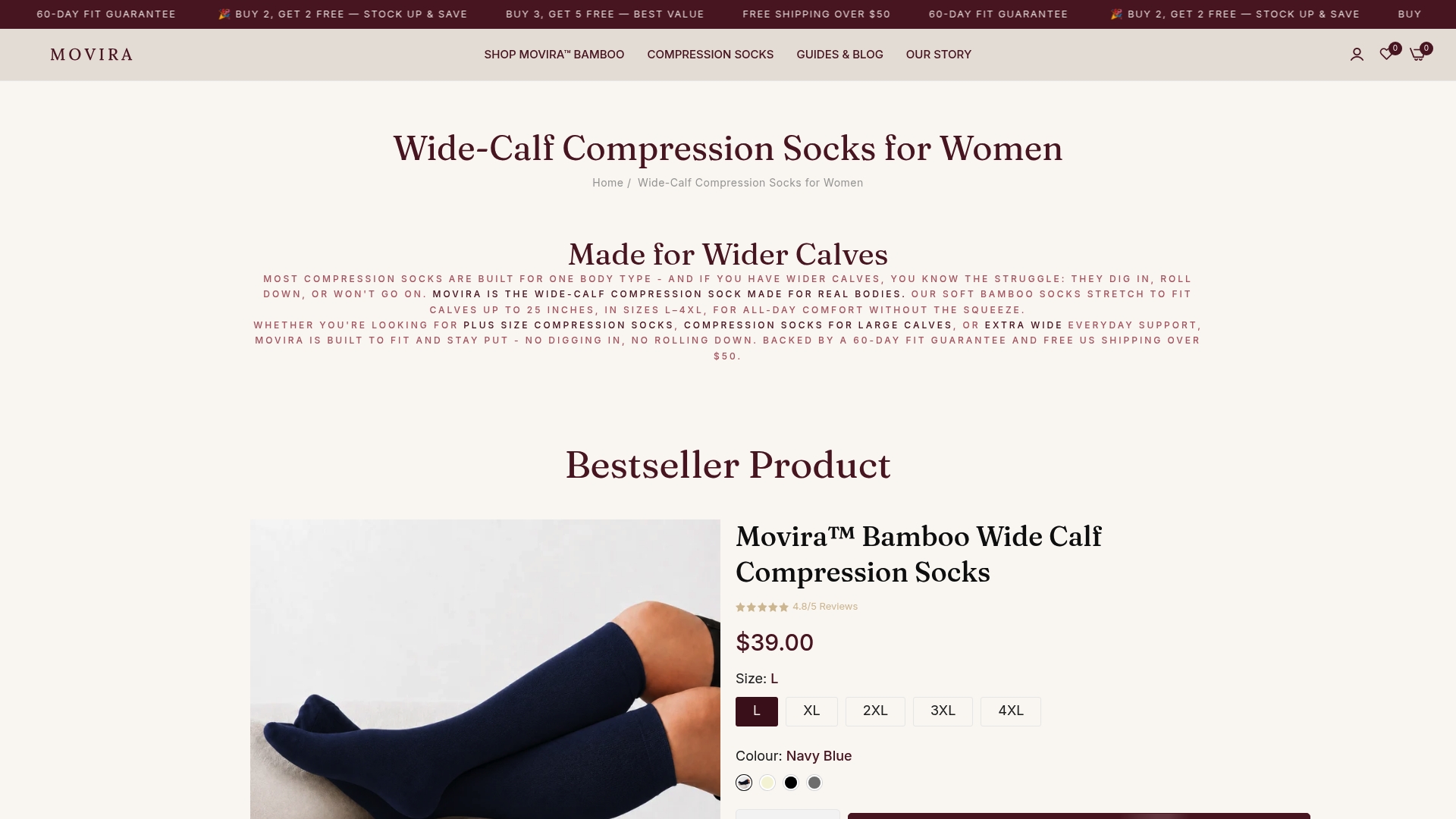
The fabric is soft, breathable bamboo, which matters more than people expect on a long flight where your feet are trapped in shoes for hours. It wicks moisture and stays comfortable for all-day wear, whether that’s a six-hour flight or a full day of travel connections. The super-stretch construction is what keeps the sock from digging in or slipping down, without needing a death grip at the top to stay up.
If you’re not sure what size fits, measure your calf at its widest point while standing, then check it against the sizing chart on the Movira™ Bamboo Wide Calf Compression Socks page. For travel comfort, most people are happy in the 15 to 20 mmHg range. Every pair comes with a 60-day fit guarantee, so if it’s not right, you’re not stuck with it. Browse the full wide-calf compression sock collection and pick your size before your next trip.
Sources
- Compression stockings for preventing deep vein thrombosis (DVT) in airline passengers | Cochrane
- Deep vein thrombosis and pulmonary embolism | CDC (Yellow Book excerpt)
- Foot swelling during air travel: A concern? | Mayo Clinic
- Long-haul flyers could reduce risk of leg blood clots with compression stockings | NIHR Evidence
FAQ
How Long Should Swelling Last After a Flight?
For most healthy travelers, swelling from a flight fades within a few hours to about a day once you’re walking around and off the plane. If swelling in one leg lasts longer than 24 hours or gets worse instead of better, that’s a signal to see a doctor rather than wait it out.
What Brings Down Swelling Fast?
Walking as soon as you can, elevating your legs above heart level for 20 to 30 minutes, and a gentle massage toward your heart are the quickest combination. Cool water soaks and properly fitted compression socks also help speed things along.
Why Do I Look Puffy After Flying?
Sitting still for hours reduces how well your calf muscles pump blood back up from your feet, so fluid settles in your lower legs and ankles. It’s called dependent edema, and it’s common, not a sign that anything is wrong with your circulation.
Do Flight Socks Stop Feet From Swelling?
Graduated compression socks don’t stop swelling completely, but a Cochrane review found they measurably reduce leg swelling on flights and lower the rate of symptomless clots. Fit matters as much as pressure, which is why wide-calf sizing helps the sock actually do its job instead of rolling down mid-flight.
Recommended
- 5 Reasons Why Women Are Switching to these Compression Socks
- 5 Reasons women switching
- Movira Bamboo Wide-Calf Compression Socks | L–4XL
This article is for general information and fit/comfort guidance only. It is not medical advice. Movira socks are everyday comfort products, not a medical or prescription device.
Tags:
Previous
Fits Up to 25 Inches: Cotton vs Bamboo Compression Socks for Women
Next
How Tight Should Compression Socks Be? A Fit Guide for Wide Calves
Related articles

Bamboo Socks: Will They Last on 25 Inch Calves?
Oct 11 2026


Plus Size Compression Socks for Women That Fit
Oct 09 2026