

Before You Buy: When Compression Socks Are Unsafe for Wide Calves
You should not wear compression socks if you have severe peripheral artery disease, severe or uncontrolled heart failure, advanced diabetic neuropathy with numbness, or any open wound, active skin infection, or fragile skin on your legs. Stop immediately and get checked if you notice new pain, numbness, color change, or swelling that keeps getting worse. When any of these apply, take the socks off and call your doctor before putting them back on.
TL;DR:
- Compression socks are unsafe for people with severe peripheral artery disease if their ankle-brachial index is below 0.6, ankle pressure under 60 mmHg, or toe pressure under 30 mmHg.
- They should be avoided by those with severe heart failure, advanced diabetic neuropathy, open wounds, infections, or fragile skin to prevent worsening conditions or infections.
- Symptoms like worsening pain, numbness, color changes, swelling above the sock, or signs of infection require immediate sock removal and medical evaluation.
- Proper fit, calf measurement, and avoiding wearing socks during sleep are essential to prevent discomfort and ineffective compression, especially for wider calves.
- Medical clearance is necessary for individuals with vascular or heart conditions before using compression socks, and sizing should prioritize comfort and correct pressure distribution.
Table of Contents
- When Not to Wear Compression Socks: Clinical Conditions That Make Compression Unsafe
- Warning Signs That Mean You Should Take Your Socks Off Right Now
- How Doctors Decide Whether Compression Is Safe for You
- Getting the Fit Right: Practical Guidance for Wider Calves
- When to Get Medical Care and What to Bring to the Appointment
- Our Take on Safety-First Fit for Wider Calves
- A Comfortable Wide-Calf Option Once You’re Cleared
- Sources
- FAQ
When Not to Wear Compression Socks: Clinical Conditions That Make Compression Unsafe
Certain conditions turn compression from helpful to harmful because the fabric’s pressure interferes with blood flow that’s already compromised. Understanding which ones apply to you (or a parent, spouse, or friend you’re helping) matters more than any sock’s fabric or fit.
Severe peripheral arterial disease (PAD) tops the list. PAD means the arteries feeding your legs are narrowed, so blood already struggles to reach your feet. Squeezing the leg with compression can choke off that already-limited supply and push a bad situation toward tissue damage. Clinicians rely on measurable cutoffs rather than guesswork, and the international consensus statement on compression risks lays them out clearly:
- An ankle-brachial pressure index (ABPI) below 0.6
- Ankle systolic pressure under 60 mmHg
- Toe pressure under 30 mmHg
Cross any of those lines, and sustained medical compression is off the table.
Severe heart failure is another firm stop sign. In NYHA class IV heart failure, compression can push extra fluid back toward the heart faster than a weakened heart can handle, according to the same consensus review. NYHA class III isn’t an automatic no, but it calls for close monitoring rather than casual daily use.
Advanced diabetic neuropathy carries a quieter danger. When nerve damage has dulled feeling in the feet and lower legs, you might not notice a sock digging in until skin breaks down. Add diabetic microangiopathy (small-vessel damage) and the risk of an unnoticed injury turning into something serious climbs further.
Finally, open wounds, cellulitis, fungal or bacterial infections, and severely fragile skin are all reasons to skip compression. Cleveland Clinic notes that compression over broken or infected skin can trap bacteria against the wound and worsen tissue damage instead of supporting it. A known allergy or strong irritation to the sock material belongs on this list too. Most people never run into these problems, and severe complications from compression are rare overall, but they cluster almost entirely among people with one of these conditions or a poor-fitting garment.
Warning Signs That Mean You Should Take Your Socks Off Right Now
A handful of symptoms mean the sock comes off before you finish reading this sentence. None of these are “wait and see” situations.
- Severe or worsening pain under the sock or anywhere in the leg, especially pain that wasn’t there when you put the sock on.
- New numbness, tingling, or loss of feeling, which can point to either nerve trouble or blood flow that’s being cut off.
- Color change, whether the skin turns pale, bluish, or blotchy, or one leg feels noticeably colder than the other.
- Swelling that spreads above the sock’s top edge, along with blistering or any break in the skin.
- Fever or spreading redness, both signs of infection that need same-day attention, not a home remedy.
A sudden painful, swollen, warm, red leg deserves particular respect. Cleveland Clinic is direct about this one: that combination can signal a deep vein thrombosis, and compression socks are not a treatment for an active clot. Don’t try to “compress through it.” Get seen.
How Doctors Decide Whether Compression Is Safe for You
Doctors don’t guess. Vascular safety comes down to a few objective numbers that tell them whether your circulation can tolerate added pressure.
- Ankle-brachial pressure index (ABPI): this compares blood pressure at your ankle to your arm. An ABPI under 0.6 is a widely used contraindication threshold for standard medical compression, because it signals arterial flow too limited to safely add pressure.
- Ankle systolic pressure: readings below 60 mmHg raise the same red flag.
- Toe pressure: below 30 mmHg, especially relevant for people with diabetes, where ankle readings can be misleading due to calcified vessels.
Borderline cases aren’t always an automatic no. Some clinicians use inelastic or modified compression with padding under close supervision when PAD is present but not severe, according to detailed guidance in the same consensus paper. That’s a decision for a vascular specialist to make, not something to try on your own. When numbers fall into a gray zone, doctors typically order a duplex ultrasound or a full vascular lab workup, or refer out to vascular medicine, before clearing anyone for ongoing compression.
Getting the Fit Right: Practical Guidance for Wider Calves
Most compression problems aren’t about whether compression is right for you. They’re about whether the sock actually fits.
- Check for even pressure. A well-fitted sock feels snug all the way up, not tight in one spot and loose in another. Measure your calf circumference before buying and size up if you’re between sizes.
- Watch for pinching or deep red marks. If you pull off your socks at night and see deep grooves that don’t fade in a few minutes, that sock is too tight or too narrow for your leg shape.
- Match the compression level to your needs. Higher mmHg grades are best reserved for a clinician’s recommendation. Lighter, over-the-counter compression is generally fine for everyday comfort unless you’ve been told otherwise.
- Stick to daytime wear. Put socks on in the morning, take them off at night. Cleveland Clinic and Mayo Clinic both advise against sleeping in standard compression garments unless a clinician specifically prescribes nighttime wear.
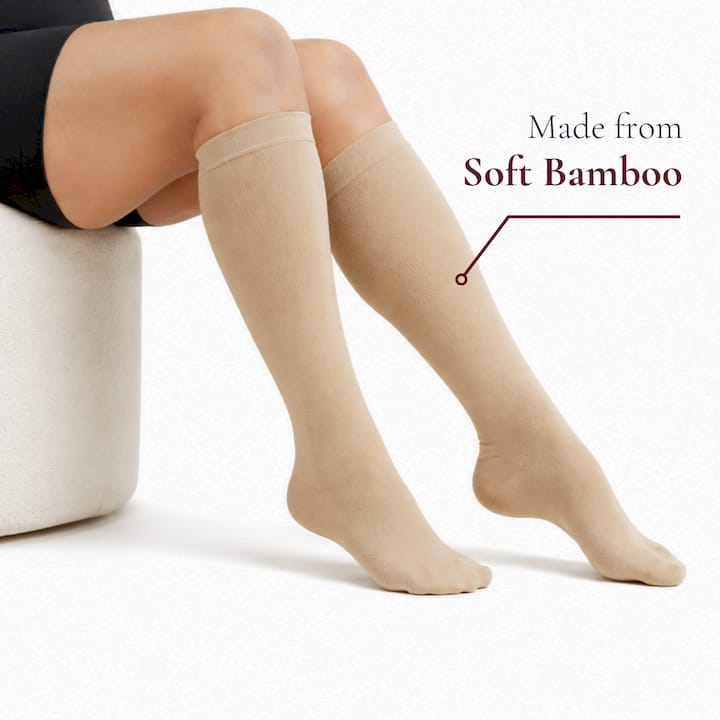
- If you have a wider calf, buy for it. Standard “one size fits most” socks tend to roll down or dig in right at the widest part of the calf, which is exactly the pressure peak you’re trying to avoid. Wide-calf styles, like Movira’s bamboo wide-calf compression socks, are built with extra stretch specifically for that shape.
- Replace worn-out socks. Elastic fibers stretch out over months of wear and washing. A sock that’s lost its stretch stops delivering even compression and starts sliding, which defeats the purpose.
Pro Tip: Take a photo of your calf measurement and the sock’s compression level (in mmHg) the day you buy it. If anything changes with your legs later, you’ll have a clear baseline to show your doctor.
When to Get Medical Care and What to Bring to the Appointment
Some symptoms need same-day care: a leg that’s suddenly painful, swollen, red, and warm; severe or spreading discoloration; or fever with worsening leg symptoms. Any of those warrants an urgent visit, not a wait-and-watch approach.
Less urgent but still worth scheduling: swelling that won’t explain itself, skin damage from a poorly fitted sock, or numbness that’s new. For that visit, bring photos of any skin changes, your calf measurements, results from prior vascular testing if you have them, and the sock’s label showing its compression level. Ask directly: do I have PAD or neuropathy? Is compression actually safe for me? What level and timing should I be wearing?
Our Take on Safety-First Fit for Wider Calves
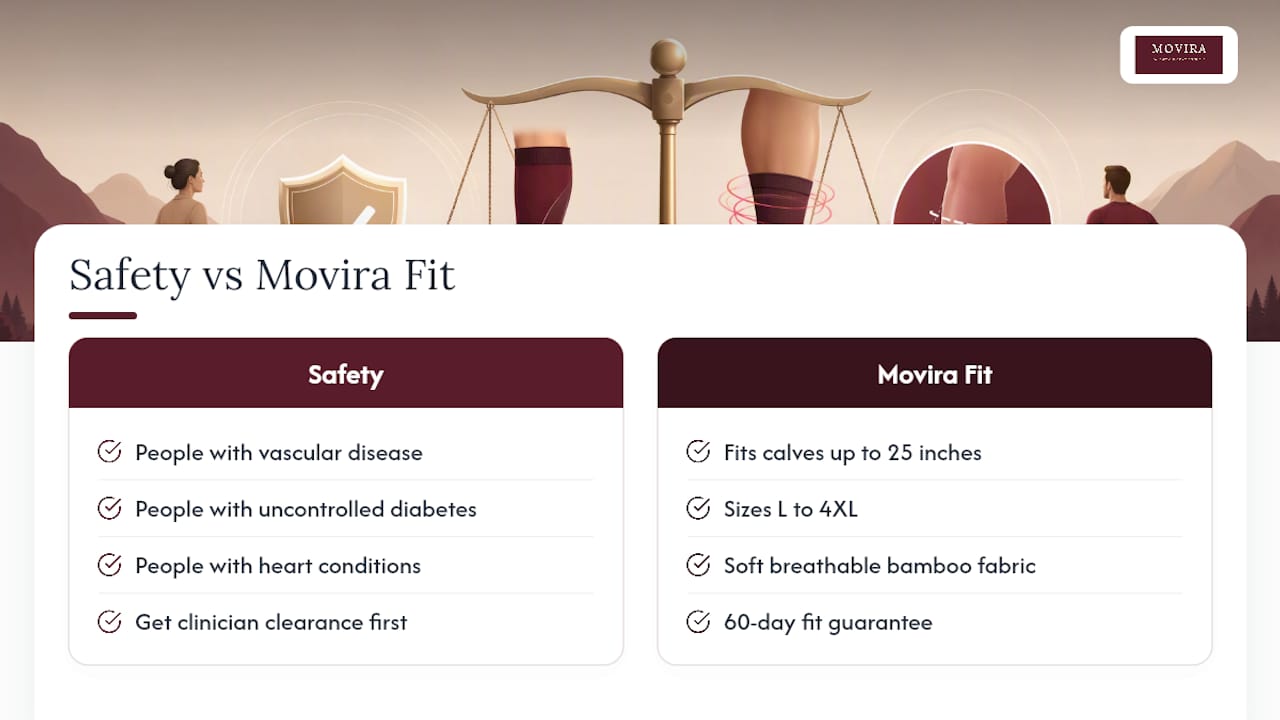
Compression socks get marketed like a wellness cure-all, and that’s part of the problem. The conversation around fit almost never mentions the flip side: for a meaningful slice of the population, especially people with vascular disease, uncontrolled diabetes, or heart conditions, compression is something to approach carefully, not something to layer on daily by default.
Movira Team built this brand around fit and comfort for wider calves precisely because so many women have been sold socks that dig in, roll down, or simply don’t fit past the knee. Our socks stretch to fit calves up to 25 inches, run from sizes L to 4XL, use soft breathable bamboo fabric, and come with a 60-day fit guarantee. None of that replaces a vascular exam. If you have any of the conditions covered above, get clearance from a clinician first. If you’re already cleared and just need a sock that stays put without pinching, our size and fit guidance can help you find the right fit.
— Movira Team
A Comfortable Wide-Calf Option Once You’re Cleared
If your doctor has given you the green light for compression and your only real frustration has been finding socks that fit your calf without sliding down or leaving marks, that’s exactly the gap Movira™ Bamboo Wide Calf Compression Socks were built to close. The soft, super-stretch bamboo fabric is cut for calves up to 25 inches, runs from sizes L through 4XL, and stays breathable enough for all-day wear without the usual digging-in or rolling-down that plagues standard sizing.
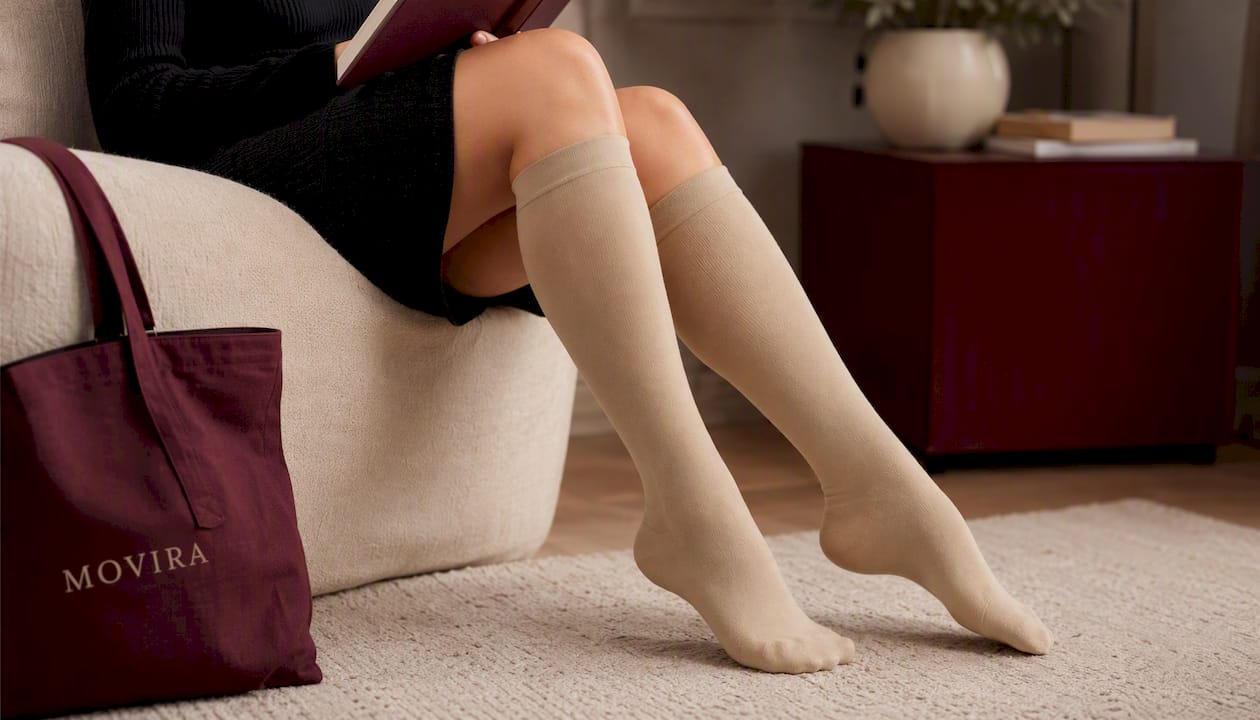
This is a comfort and fit product, not a medical device, so use it as one more tool in your day once a clinician has ruled out the conditions covered above. Every pair ships with a 60-day fit guarantee, so if the fit isn’t right, you’re not stuck with it. Browse the full wide-calf compression sock collection or go straight to the bamboo wide-calf socks to check sizing against your own calf measurement today.
This article is general information, not a substitute for advice from a qualified doctor. Consult a qualified healthcare professional about your own circumstances before acting on anything here.
Sources
- Risks and contraindications of medical compression treatment – A critical reappraisal. An international consensus statement
- What To Know About Compression Socks
- Compression garments: use, care, and maintenance guide — Mayo Clinic Store
FAQ
What are the signs you shouldn’t wear compression socks?
Pain, numbness, tingling, skin discoloration, coldness, or swelling that worsens after putting on compression socks are all signs to stop wearing them, according to Mayo Clinic. Any of these signs warrants removing the socks and calling your doctor rather than waiting it out.
What are the rules for wearing compression socks?
Put them on in the morning, take them off at night unless your doctor prescribes nighttime wear, and never wear them over open wounds, active infections, or severely fragile skin, per Cleveland Clinic. Fit matters just as much as the rules: a sock should feel evenly snug with no pinching or deep marks after removal.
When should you stop wearing compression socks?
Stop the moment you notice new pain, numbness, color change, or swelling that spreads above the sock’s edge, and stop entirely if you’re diagnosed with severe PAD, severe heart failure, or advanced neuropathy. Thresholds like an ABPI below 0.6 are what clinicians use to make that call for you.
Can tight compression socks cause blood clots?
Compression socks don’t cause blood clots when properly fitted and used as intended, but a sudden painful, swollen, red, and warm leg can signal a deep vein thrombosis that needs urgent care, not compression, according to Cleveland Clinic. A sock that’s genuinely too tight can also restrict circulation, which is why proper wide-calf sizing matters so much for comfort and even pressure.
Is Movira safe to wear if I have a vascular condition?
Movira™ Bamboo Wide Calf Compression Socks are a comfort and fit product, not a medical device, so anyone with a vascular condition, diabetes, or heart failure should get clinician clearance before wearing any compression sock. Once you’re cleared, the bamboo wide-calf design is built to fit calves up to 25 inches without digging in or rolling down.
Recommended
- Wide-Calf Bamboo Compression Socks (L–4XL)
- Movira Bamboo Wide-Calf Compression Socks | L–4XL
- PERSONAL STORY / COMPARISON
- Tried Every Compression Sock
This article is for general information and fit/comfort guidance only. It is not medical advice. Movira socks are everyday comfort products, not a medical or prescription device.
Tags:
Previous
Stylish, Supported Compression Socks for Wide Calves Up to 25 Inches
Next
How to Measure Your Calves for Compression Socks (3 Easy Steps)
Related articles
Compression Leggings vs Socks: What to Wear
Nov 20 2026
Zipper Compression Socks Problems: What to Know
Nov 20 2026
Compression Levels Explained for Everyday Wear
Nov 20 2026

Graduated Compression for Wide Calves: Daily Use
Nov 17 2026

Tight Socks? How to Find a Comfortable Fit
Nov 17 2026
Light Compression Socks for Women: When to Wear
Nov 15 2026

Knee High Socks for Wide Calves: How to Choose
Nov 14 2026
Wide Calf Compression Guide: Find Your Fit
Nov 13 2026