Fit First: Support Socks vs Compression for Calves Up to 25 Inches
Pick support socks if you want light, all-day comfort and a bit of leg fatigue relief. Pick real compression socks, measured in mmHg, if you’re managing swelling, circulation concerns, or recovery and need graduated pressure that a clinician may want to weigh in on. The mmHg number on the label, not the word “compression” on the package, is what actually tells you what a sock does.
TL;DR:
- Proper fit is crucial, with ankle measurement taking priority over calf circumference, especially for higher mmHg compression levels.
- Lightweight support socks are suitable for daily comfort and mild fatigue relief, but effective compression socks require accurate sizing and graduated pressure profiles.
- Medical-grade compression, especially above 20 mmHg, should be prescribed and fitted under healthcare professional guidance to avoid circulation issues.
- Wide-calf compression socks made from breathable fabrics like bamboo improve comfort for larger calves, preventing rolling and digging-in during wear.
- Wearing compression socks for extended hours or daily use demands attention to fit and material; ill-fitting socks can reduce benefits or cause discomfort.
Table of Contents
- Support Socks vs Compression Socks: A Quick Comparison
- What’s the Real Difference Between Support and Compression Socks?
- What Does mmHg Actually Mean for Your Legs?
- Which Sock Fits Your Situation: Travel, Work, Sports, or Medical Needs
- How Do You Measure Your Calf for the Right Fit?
- Materials and Comfort: What Actually Changes Daily Wear
- When Should You Not Wear Compression Socks?
- Our Take: Fit Comes Before Everything Else
- Bamboo Wide-Calf Compression Socks Built to Actually Stay Put
- Sources
- FAQ
Support Socks vs Compression Socks: A Quick Comparison
The two categories look similar on a store shelf but do different jobs. Here’s the breakdown that actually matters when you’re standing in an aisle trying to decide:
- Purpose: Support socks ease general leg fatigue and offer mild, even pressure. Compression socks apply graduated pressure specifically to support circulation.
- Pressure style: Support socks use uniform, low pressure throughout. Compression socks are tightest at the ankle and ease up the leg, a design called graduated compression.
- Length and coverage: Both come in knee-high, over-the-knee, and sometimes waist-high styles, though medical compression is more likely to be fitted precisely to length.
- Who wears them: Support socks suit people on their feet all day, travelers, and anyone wanting extra comfort without a medical need. Compression socks are used by people managing swelling, varicose veins, post-surgical recovery, or long-haul travel risk, often on a clinician’s recommendation.
- Price and replacement: Support socks are typically less expensive and last longer since the elastic isn’t working as hard. Compression socks, especially higher mmHg pairs, lose some elasticity faster and need replacing every few months with regular wear.
If you’re packing for a flight or heading into a 10-hour shift on your feet, support socks or light compression will usually do the job. If you’re dealing with a diagnosed circulation issue, that’s when a prescription-strength pair and a conversation with your doctor make sense.
What’s the Real Difference Between Support and Compression Socks?
Support socks are the more casual cousin. They’re sold over the counter, use a uniform level of light pressure, and often come with extra cushioning or padding in the sole. Think of them as a comfort upgrade to a regular sock, built for people who stand or walk a lot and want less end-of-day heaviness in their legs.
Compression socks are engineered differently. They use graduated compression, meaning the pressure is measured in mmHg and is strongest at the ankle, decreasing as it moves up the leg. That gradient is what’s backed by research showing it helps venous return, the process of blood moving back up toward the heart.
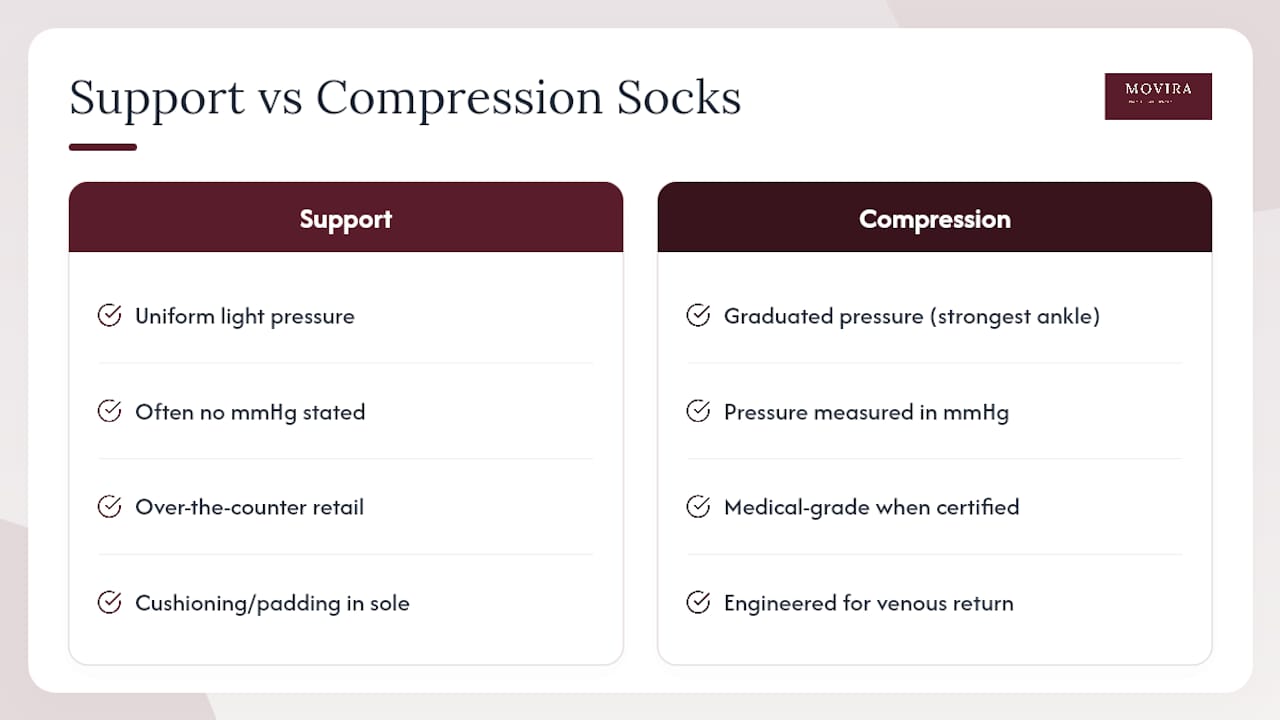
Here’s where it gets murky: plenty of “sports compression” and “athletic compression” gear on the market never publishes an actual mmHg number. According to a comparison from Herzog Medical on support versus compression stockings, many retail products marketed as compression lack a certified, graduated pressure profile, so they can’t be assumed equivalent to medical-grade compression. If the label doesn’t state a pressure range, you’re likely looking at a support product wearing a compression label.
What Does mmHg Actually Mean for Your Legs?
mmHg stands for millimeters of mercury, the same pressure unit used for blood pressure readings. On a compression sock, it tells you how much force the fabric applies to your leg, and graduated compression means that force is highest at the ankle and gradually lower as it climbs toward the knee or thigh.
Compression is generally grouped into a few common ranges:
Compression is generally grouped into a few common qualitative ranges: mild compression often marketed for everyday or travel support; a higher level suitable for tired, achy legs or mild swelling; moderate compression sometimes used for noticeable swelling or with medical guidance; and stronger compression levels typically requiring prescription and professional fitting for specific circulatory conditions.
A pair labeled 20/30 mmHg only delivers that pressure if the fit is accurate. A sock sized too big won’t apply the pressure the label promises, and one sized too small can feel constricting without added benefit. Clinical research on compression therapy confirms that effectiveness depends on both the correct pressure level and correct fit, not the number alone. Beyond 20 mmHg, it’s worth looping in a clinician, since that’s the range where medical oversight starts to matter more.
Which Sock Fits Your Situation: Travel, Work, Sports, or Medical Needs
Matching your day-to-day reality to the right sock saves you money and disappointment. Here’s how it typically breaks down:
- Standing jobs and general fatigue. If you’re a teacher, nurse, retail worker, or anyone on your feet for hours, support socks with cushioned soles are usually enough. You’re solving for comfort, not circulation.
- Travel and mild swelling. Light compression in the 15 to 20 mmHg range is a common choice for flights or road trips, helping with the puffiness that comes from sitting still for hours. No prescription needed.
- Diagnosed circulatory conditions or post-surgical recovery. This is where 20 mmHg and above enters the picture, and it’s worth talking to a doctor first since fit and pressure level both matter for what you’re managing.
- Athletic recovery. Runners and endurance athletes often reach for compression sleeves or socks after workouts. Some trials have found compression garments can ease muscle soreness and support recovery markers when they’re properly fitted, though plenty of “sports compression” gear skips publishing real pressure data, so fit and feel during activity matter more than the label.
How Do You Measure Your Calf for the Right Fit?
Fit failures are the number one reason compression and support socks end up in a drawer unworn. Measure both your ankle circumference and the widest part of your calf, ideally first thing in the morning before swelling builds up through the day. Medical-grade stockings use precise measurement points, ankle, calf, and sometimes thigh, to calculate the pressure gradient correctly, while most retail sizing charts are looser and based on shoe size or general small/medium/large ranges.
Common fit problems and fixes:
- Digging in at the top of the calf: Usually means the sock is too narrow for your calf circumference, not too short. Sizing up in width, not length, solves this.
- Rolling down during the day: Often caused by a top band that’s too tight combined with a knit that doesn’t have enough stretch to move with you.
- Overall tightness despite “correct” size: Standard sizing rarely accounts for wider calves, which is why wide-calf specific sizing exists as its own category rather than a workaround.
Pro Tip: Measure your calf while standing, not sitting. Standing engages the muscle and gives you a more accurate number than a relaxed, seated measurement.
Movira’s approach documents its own testing and sizing process built specifically around wider calves, offering sizes L through 4XL that fit calves up to 25 inches, backed by a 60-day fit guarantee if the fit isn’t right.
Materials and Comfort: What Actually Changes Daily Wear
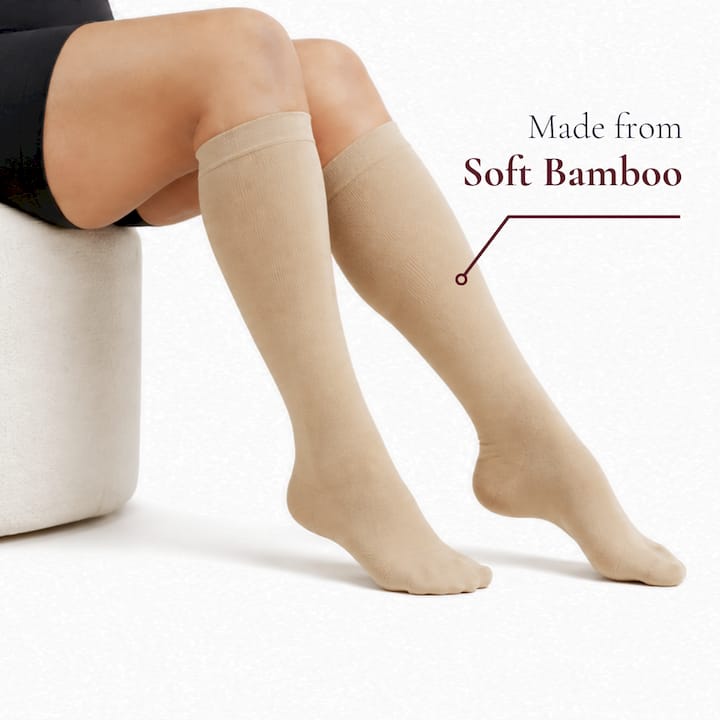
Fabric choice affects how a sock feels by hour eight of wear, not just how it looks on day one. Bamboo fabric tends to run softer and more breathable than standard cotton blends, with better moisture management for anyone on their feet through a warm afternoon. Synthetic blends like nylon and spandex hold compression well but can feel less breathable over a full day.
Support socks often build in extra cushioning or padded footbeds, since comfort under the foot is the main goal. Compression socks favor a thinner, firmer knit because the priority is holding a consistent pressure gradient rather than cushioning.
One trade off worth knowing: tighter compression fabric tends to lose elasticity faster than a support sock’s looser weave, which means compression socks in daily rotation often need replacing sooner. Stretch fabrics like bamboo blends can help reduce binding at the top of the calf, a common complaint among women switching to wide-calf compression styles.
When Should You Not Wear Compression Socks?
Compression isn’t automatically safe for everyone, and certain conditions call for caution before putting on a pair. Common contraindications include:
- Peripheral artery disease (PAD): Compression can worsen circulation in legs with reduced arterial blood flow.
- Severe peripheral neuropathy: Reduced sensation can mask early signs that a sock is too tight.
- Uncontrolled heart failure: Added pressure can shift fluid in ways that need medical supervision.
- Active skin infection or open wounds on the leg.
Clinical guidance on compression therapy documents that improper compression, or use in patients with arterial disease, can worsen circulation rather than help it.
Stop wearing compression and check with a doctor if you notice numbness, increasing pain, or changes in skin color or temperature in your foot or toes. Anything above 20 mmHg generally deserves a professional fitting rather than a guess based on a sizing chart.
Our Take: Fit Comes Before Everything Else
Most advice on compression jumps straight to mmHg numbers and skips the part that actually determines whether someone keeps wearing the socks past week one: fit. A perfectly rated 20/30 mmHg pair that digs in behind the knee or rolls down by lunchtime does less for you than a well-fitted 15/20 mmHg pair worn consistently.
Our rule of thumb: nail ankle fit first, then check calf circumference, and don’t assume a “large” in a generic sizing chart accounts for a wider calf. If you’re just testing the waters, a light 15/20 mmHg pair at home is a reasonable place to start. Save the professional fitting for anything higher. Comfort features like stretch fabric and a stay-up design without a tight top band aren’t extras. They’re what makes someone actually wear the socks every day instead of leaving them in a drawer, which is the only way any sock, support or compression, does its job at all.
— Movira Team
Bamboo Wide-Calf Compression Socks Built to Actually Stay Put
If you’ve read this far, you already know the biggest failure point isn’t the mmHg number, but the fit. Movira makes bamboo wide-calf compression socks specifically for calves up to 25 inches, in sizes L through 4XL, so you’re not stuck squeezing into a “large” that was never built with a wider calf in mind.
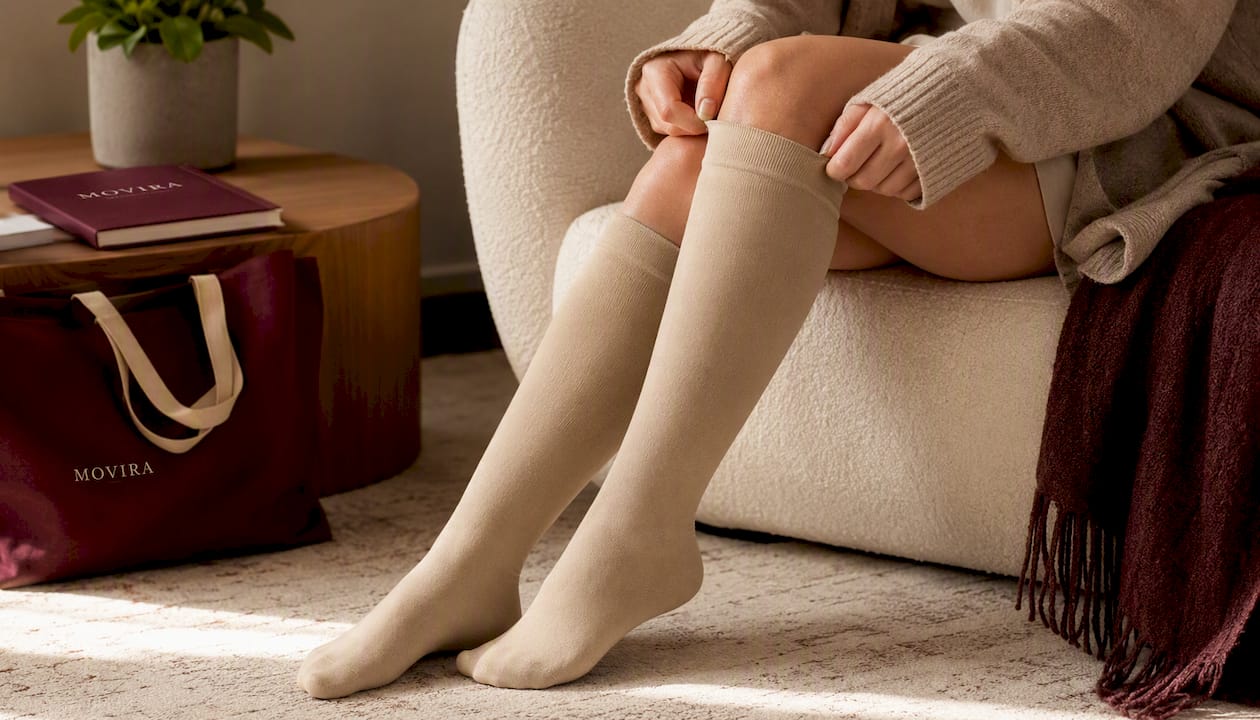
Each pair uses soft, breathable bamboo fabric with 15 to 20 mmHg graduated compression, designed to stay up without digging in or rolling down by afternoon. Whether you’re on a long flight, standing through a full shift, or just want socks that feel good by hour ten, this is built for daily comfort rather than a one-time wear. Every order comes with a 60-day fit guarantee, so if the fit isn’t right, you have real time to find out. Browse the full wide-calf compression sock collection and find your size today.
Sources
Key references include PubMed research on graduated compression and venous return, a systematic review on compression therapy effectiveness, and medi’s comparison of support versus medical compression stockings. For fit-specific guidance, see Movira’s personal fit comparison story.
This article is general information, not a substitute for advice from a qualified doctor. Consult a qualified healthcare professional about your own circumstances before acting on anything here.
- PubMed entry on compression effects (source used for physiologic grounding)
- PubMed systematic review on compression therapy effectiveness
- Study on compression garments and athletic recovery
- Clinical caution on compression therapy in patients with arterial disease
FAQ
When should you not wear compression socks?
Avoid compression socks if you have peripheral artery disease, severe neuropathy, uncontrolled heart failure, or an active skin infection on your leg, and check with a doctor first if you’re unsure.
Which is better, 15/20 mmHg or 20/30 mmHg compression socks?
Neither is universally “better.” 15/20 mmHg suits everyday comfort, travel, or mild fatigue without a prescription, while 20/30 mmHg is typically for diagnosed circulatory issues and works best under a clinician’s guidance.
How many hours should you wear compression socks for?
Most people wear compression socks during waking hours, putting them on in the morning and removing them before bed, though the exact duration depends on your reason for wearing them and any guidance from a doctor.
Where does fluid go when you wear compression socks?
Graduated compression encourages fluid and blood to move upward through the veins back toward the heart instead of pooling in the lower leg and ankle.
Are compression socks worth it for everyday comfort?
If you’re not managing a medical condition, a well-fitted pair with graduated compression or even a good support sock can genuinely ease end-of-day leg fatigue, especially when the fit, like Movira’s wide-calf sizing, actually matches your calf shape.
Recommended
- 5 Reasons Why Women Are Switching to these Compression Socks
- Tried Every Compression Sock
- Movira Bamboo Wide-Calf Compression Socks | L–4XL
This article is for general information and fit/comfort guidance only. It is not medical advice. Movira socks are everyday comfort products, not a medical or prescription device.
Tags:
Previous
Compression Socks and Circulation: What to Know for Wide Calves
Next
2–4 Years vs a Decade: Bamboo Viscose vs Cotton for Sensitive Skin
Related articles
Plus Size Compression Socks for Women That Fit
Oct 09 2026