

Compression Sock Sizing for Wide Calves Up to 25 Inches
To size compression socks correctly, measure your ankle, calf, and lower-leg length in the morning, then match those numbers to the product’s own size chart. Most everyday wear calls for 15–20 mmHg, while higher compression ranges demand more precise measuring and sometimes a professional fitting. If your calf measures up to 25 inches, look for a wide-calf option like Movira™ Bamboo Wide Calf Compression Socks instead of forcing a standard size to stretch.
TL;DR:
- Accurate measurement of ankle, calf, and leg length in the morning is essential for a proper fit, especially for higher compression levels.
- A half-inch error in measurement can significantly impact comfort and effectiveness at 30–40 mmHg, but is less critical at 15–20 mmHg.
- Wide-calf options like Movira’s bamboo socks are designed for calves up to 25 inches, preventing tightness or slippage common in standard sizes.
- Proper fit is confirmed by a sock feeling firm at the ankle, smoothly loosening up the leg without bunching or indentations.
- Re-measuring every 6 to 12 months or after changes in weight or swelling improves fit accuracy, especially in cases of fluctuating leg conditions.
Table of Contents
- How Do You Measure Your Legs for Compression Socks?
- What Do 15–20, 20–30, and 30–40 mmHg Actually Mean?
- How Do You Match Your Numbers to a Size Chart?
- How Can You Tell If Your Compression Socks Fit Right?
- When Should You Get a Professional Fitting?
- Why Movira’s Bamboo Wide-Calf Socks Solve Common Fit Problems
- How Do You Measure If Swelling or Limited Mobility Gets in the Way?
- A Short Note From the Movira Team on Fit and Comfort
- Where to Buy Movira Bamboo Wide-Calf Compression Socks
- Sources
- FAQ
How Do You Measure Your Legs for Compression Socks?
Grab a soft fabric measuring tape, a pen, and paper before you start; for practical measuring guidance and visual tips, check out the Vegan Combat Boots Size Guide, which models clear measurement photos and stepwise tips that translate well to compression sock measurements. Measure first thing in the morning, when your legs are at their least swollen. If morning measuring isn’t possible, lie down and prop your legs up on a pillow for 10 to 15 minutes first to get closer to a true baseline.
Here’s the exact sequence to follow:
- Ankle. Wrap the tape around the narrowest part of your ankle, just above the anklebone. Keep the tape snug but not tight enough to dent the skin, and write down the number in inches.
- Calf. Stand with your weight even on both feet and wrap the tape around the widest part of your calf. Keep the tape level all the way around, since a tilted tape reads short.
- Leg length. For knee-high socks, measure from the floor to the crease behind your knee while standing. For thigh-highs, continue up to the crease where your thigh meets your buttock.
Measure both legs. Legs are rarely identical, and using the larger measurement keeps the sock from cutting off circulation on your bigger leg while still fitting the smaller one comfortably.
Pro Tip: Measure over bare skin, not over leggings or trouser fabric. Even thin fabric adds enough bulk to throw your calf number off by half an inch, which is often the gap between one size and the next.
What Do 15–20, 20–30, and 30–40 mmHg Actually Mean?
Compression is measured in millimeters of mercury (mmHg), the same unit used for blood pressure. The number tells you how much pressure the fabric applies at the ankle, tapering upward.
- 15–20 mmHg: The standard everyday level, good for travel, long shifts on your feet, and general leg comfort.
- 20–30 mmHg: Firmer, medical-grade compression often recommended by a doctor for specific circulation concerns.
- 30–40 mmHg: Extra-firm compression generally reserved for severe clinical needs and usually fitted under professional guidance.
That breakdown comes from Mayo Clinic’s guidance on compression stockings, and it’s worth remembering because the higher the mmHg, the less forgiving the sizing becomes. A half-inch measuring error barely matters at 15–20 mmHg. At 30–40 mmHg, that same error can mean a sock that’s genuinely uncomfortable. For daily wear, 15–20 mmHg has enough stretch built in to tolerate small measuring slips, which is exactly why it’s the level most people reach for first. Athletes sometimes size down slightly within the same mmHg range for a firmer, more locked-in feel during activity.
How Do You Match Your Numbers to a Size Chart?
No two brands size the same way, so a “medium” from one company might be a “large” somewhere else. Always check whether the chart you’re reading uses inches or centimeters. Mixing them up is one of the most common ordering mistakes, and it’s an easy one to make when you’re comparing a few different product pages at once.
A few rules make the process faster:
- If your calf circumference lands in a brand’s wide-calf range, roughly 17 to 25 inches based on how most wide-calf constructions are built, choose the wide-calf option rather than sizing up in the standard line.
- When you fall between two sizes, prioritize your ankle measurement for proper graduated compression and your calf measurement for comfort.
- For athletic use, size down slightly toward a firmer feel; for all-day wear, size up toward comfort.
- Check the brand’s length cutoffs for short, regular, and long. Sizing too short makes the top band roll down below the knee; too long makes it bunch or fold behind the knee.
Sizing by calf alone and ignoring ankle fit is a common misstep. Ankle circumference is the measurement that most strongly determines whether the graduated compression actually works the way it’s designed to, according to iCompressionSocks’ measuring research.
How Can You Tell If Your Compression Socks Fit Right?
A properly fitted sock feels firmest at the ankle, gradually looser as it moves up your leg, with no folds or bunching anywhere along the fabric.
Watch for these three problems:
- Too tight: Numbness, tingling, deep red marks that don’t fade within a few minutes, or visible indentation are signs to size up immediately.
- Too loose: Sliding down during the day, bunching at the ankle, or a top band that feels like it’s doing nothing all point to a size too big.
- Measuring mistakes: Measuring over clothing, measuring in the evening after your legs have swollen, pulling the tape too tight for a “better” number, or guessing your size from your shoe size all lead to poor fits.
Once socks are on, the top band should sit about two finger widths below the back of your knee, according to fit-check guidance from CEP Running. If it’s pressing right into the crease, the length is wrong, not the size.
When Should You Get a Professional Fitting?
Reach for professional measuring if you’re considering 20–30 mmHg or higher, if you deal with significant swelling that changes throughout the day, or if your leg shape is unusually tapered or cylindrical, since higher compression levels leave less room for measuring error.
Even without a fitting appointment, remeasure every 6 to 12 months, and always after weight changes, pregnancy, or surgery. If your swelling fluctuates, measure in the morning and again in the evening to see your actual range, then choose a wide-calf or more adjustable option that comfortably covers both numbers.
Why Movira’s Bamboo Wide-Calf Socks Solve Common Fit Problems
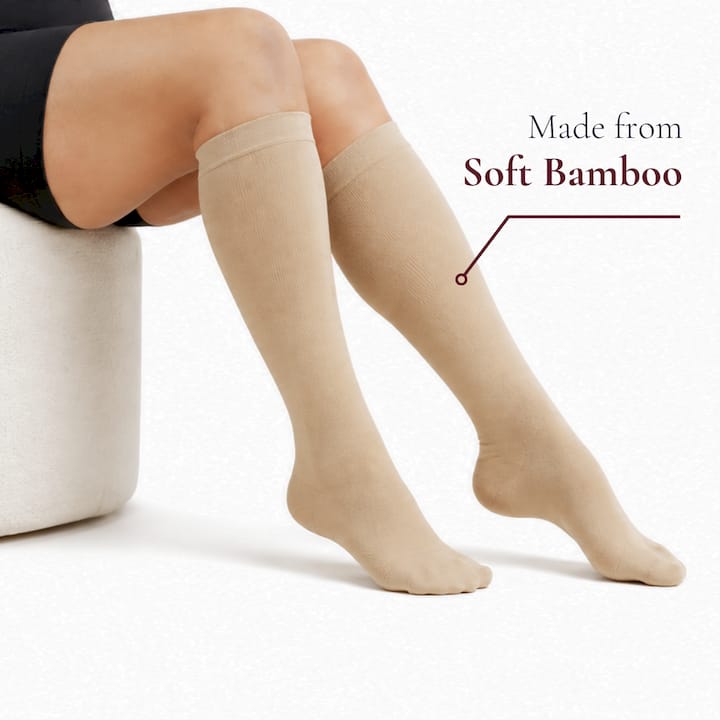
Standard compression socks are usually built for one calf shape, which is exactly why so many women with fuller or muscular calves end up with a band that digs in or a sock that won’t stay up. Movira™ Bamboo Wide Calf Compression Socks are cut for calves up to 25 inches, across sizes L to 4XL, at a 15–20 mmHg everyday compression level. The super-stretch bamboo fabric gives the extra room wider calves need, without the tightness or slippage that pushes so many women to size up unnecessarily. It’s soft, breathable, and backed by a 60-day fit guarantee, so if your measurements don’t translate into real comfort, you’re covered. Browse the full wide-calf compression sock collection once you’ve got your numbers.
How Do You Measure If Swelling or Limited Mobility Gets in the Way?
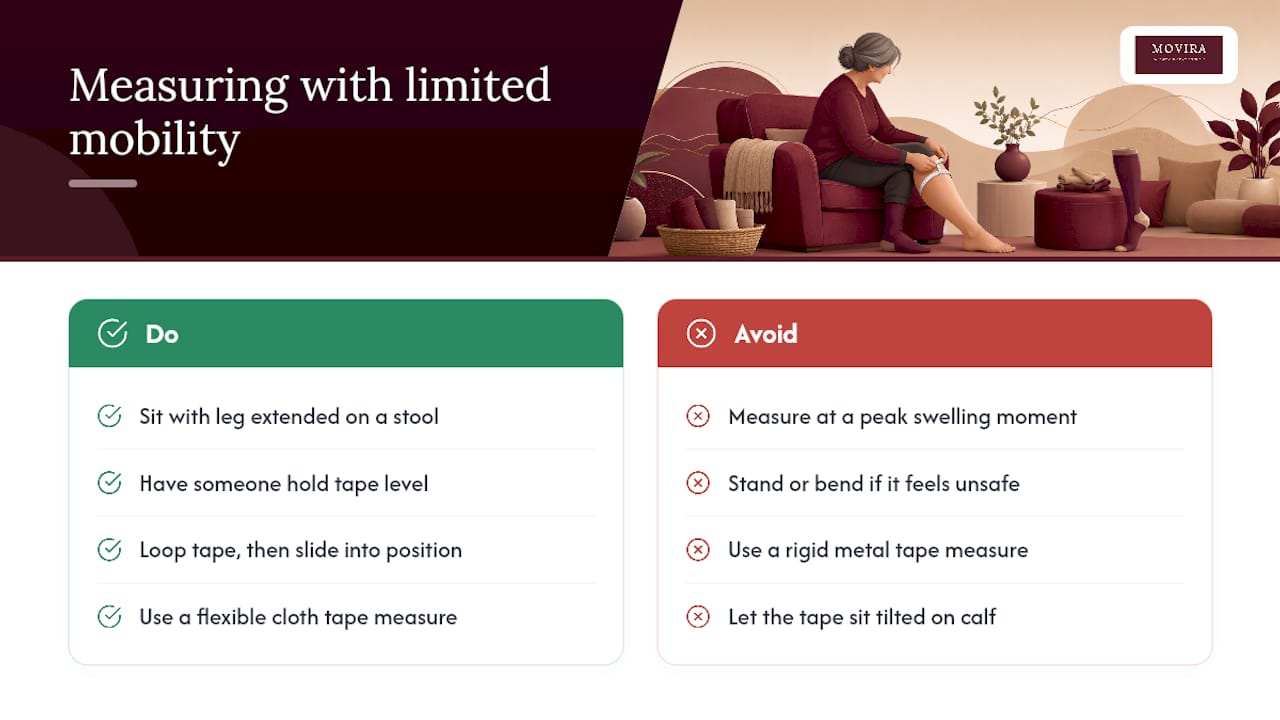
Standard tape-measure steps assume you can stand steadily and bend to reach your ankle and calf, but that’s not realistic for everyone. If swelling changes your leg shape throughout the day, or standing for measuring feels unsafe, there are workarounds.
Sit in a supportive chair with your leg extended on a stool or ottoman rather than standing. This keeps you steady and still gives you access to both the ankle and calf without shifting your weight around. Ask someone else to hold the tape level while you read the measurement, especially for the calf, where a tilted tape is the single biggest source of error.
If bending forward to reach your ankle is difficult, loop the tape loosely around first, then slide it into position rather than reaching down repeatedly. A flexible cloth tape works far better here than a rigid metal one, since it follows the curve of your leg without you needing to hold it taut from an awkward angle.
For fluctuating swelling, take your measurement at your typical daily baseline rather than at a peak swelling point, unless a doctor has told you otherwise for a specific medical reason. Recording measurements on two or three different days, at similar times, gives you a more reliable number than a single reading. When measuring independently isn’t possible at all, a caregiver, pharmacist, or home health aide can often help, and it’s worth asking a healthcare provider for a guided fitting if you have significant mobility limitations.
A Short Note From the Movira Team on Fit and Comfort
We know how discouraging it is to order a size based on a guess and have it show up too tight or sliding down by lunchtime. Taking five extra minutes to measure properly, morning light, both legs, larger number, changes everything about how a sock actually feels on your leg. And if you still get it wrong, our 60-day fit guarantee means it’s not the end of the story.
— Movira Team
Where to Buy Movira Bamboo Wide-Calf Compression Socks
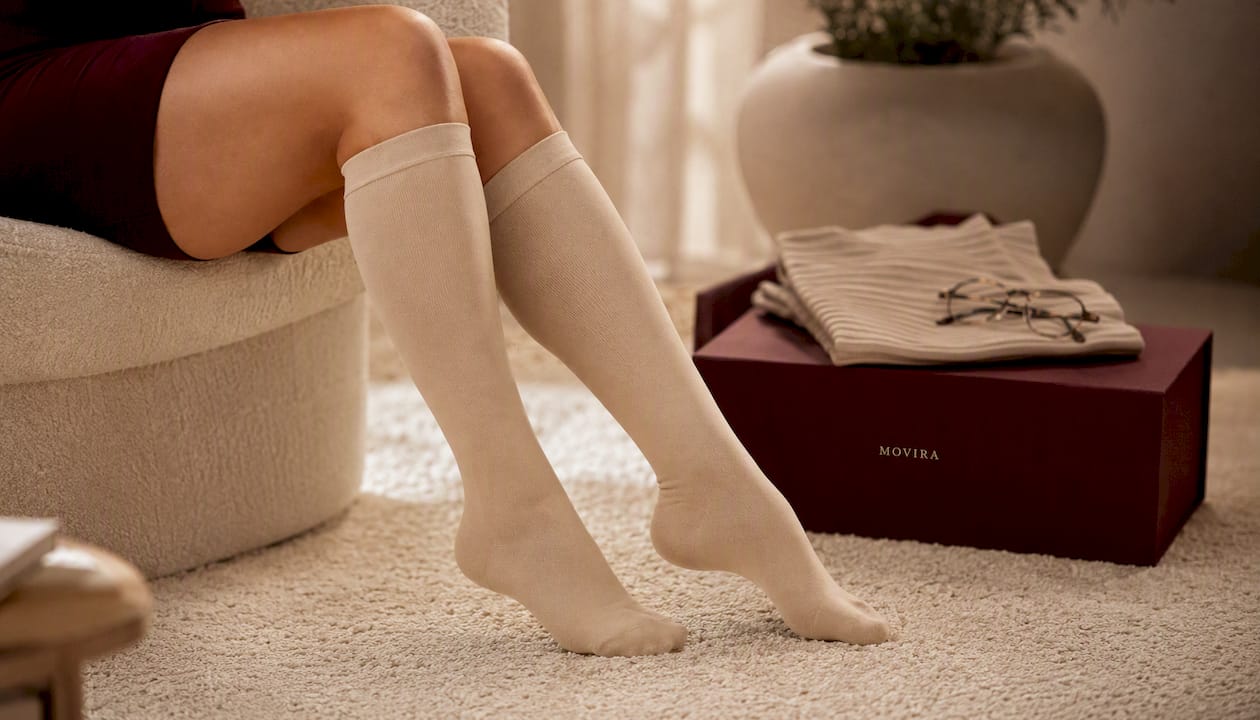
Once you’ve got your morning measurements in hand, finding the right pair shouldn’t take another round of guesswork. Movira™ Bamboo Wide Calf Compression Socks are built specifically for calves up to 25 inches, across sizes L through 4XL, at a comfortable 15–20 mmHg, in a soft bamboo fabric designed to stay put without digging in or rolling down.
For a closer look at how the fabric compares to other materials on the market, the bamboo sock comparison breakdown walks through why bamboo tends to breathe better over a full day of wear. If you’ve already got your ankle, calf, and length numbers ready, head straight to the product page to match them against the size chart and order with your 60-day fit guarantee in place.
Sources
- iCompressionSocks — Step-by-step measuring guide
- TensNet — How to measure compression socks: step-by-step
- TRUEENERGY® Socks — What size compression socks do I need?
FAQ
Which Is Tighter, 15/20 or 20/30 Compression Socks?
20–30 mmHg applies noticeably more pressure than 15–20 mmHg. Mayo Clinic classifies 15–20 mmHg as the standard everyday level and 20–30 mmHg as firmer, medical-grade compression.
Should You Size Up on Compression Socks?
Size up when your measurement falls between two sizes and you want all-day comfort, especially if your calf is near a wide-calf threshold like the 25-inch range Movira accommodates. Size down only for a firmer, athletic feel during short bursts of activity.
How Can You Tell If Your Compression Socks Are Tight Enough?
You should feel the firmest pressure at your ankle, gradually loosening as the sock moves up your leg, with no numbness, tingling, or lasting red marks. If the top band presses into the back of your knee or the fabric bunches anywhere, the fit or length is off.
Who Should Wear 30–40 mmHg Compression Socks?
30–40 mmHg is generally reserved for severe clinical needs and is typically recommended and fitted under professional guidance rather than chosen off a standard size chart. Anyone considering this level should get measured by a healthcare provider rather than measuring at home.
What Compression Level Is Best for Everyday Comfort?
For most daily wear, travel, and long hours on your feet, 15–20 mmHg offers the most forgiving fit, which is why it’s the level used in Movira’s bamboo wide-calf socks.
Recommended
- 5 Reasons Why Women Are Switching to these Compression Socks – Movira
- Wide-Calf Bamboo Compression Socks (L–4XL) | Movira
- Movira Bamboo Wide-Calf Compression Socks | L–4XL
This article is for general information and fit/comfort guidance only. It is not medical advice. Movira socks are everyday comfort products, not a medical or prescription device.
Tags:
Previous
Wide Calves: Stop Compression Socks From Digging In (Fits up to 25")
Next
Get Compression Socks On in Under a Minute for Wide Calves
Related articles
Compression Leggings vs Socks: What to Wear
Nov 20 2026
Zipper Compression Socks Problems: What to Know
Nov 20 2026
Compression Levels Explained for Everyday Wear
Nov 20 2026

Graduated Compression for Wide Calves: Daily Use
Nov 17 2026

Tight Socks? How to Find a Comfortable Fit
Nov 17 2026
Light Compression Socks for Women: When to Wear
Nov 15 2026

Knee High Socks for Wide Calves: How to Choose
Nov 14 2026
Wide Calf Compression Guide: Find Your Fit
Nov 13 2026