Socks That Fit 25 Inch Calves: Bamboo vs Merino for Hikes and Heat
Choose merino if you spend long days outdoors, sweat heavily, or need odor control that survives a week of travel. Choose bamboo if you want an immediately cool, silky feel and a lower price for everyday or hot-weather wear. Most people who can't decide end up happiest in a blend — and if wider calves make sock shopping miserable, a stretch bamboo option built for that fit problem solves an entirely different headache.
TL;DR:
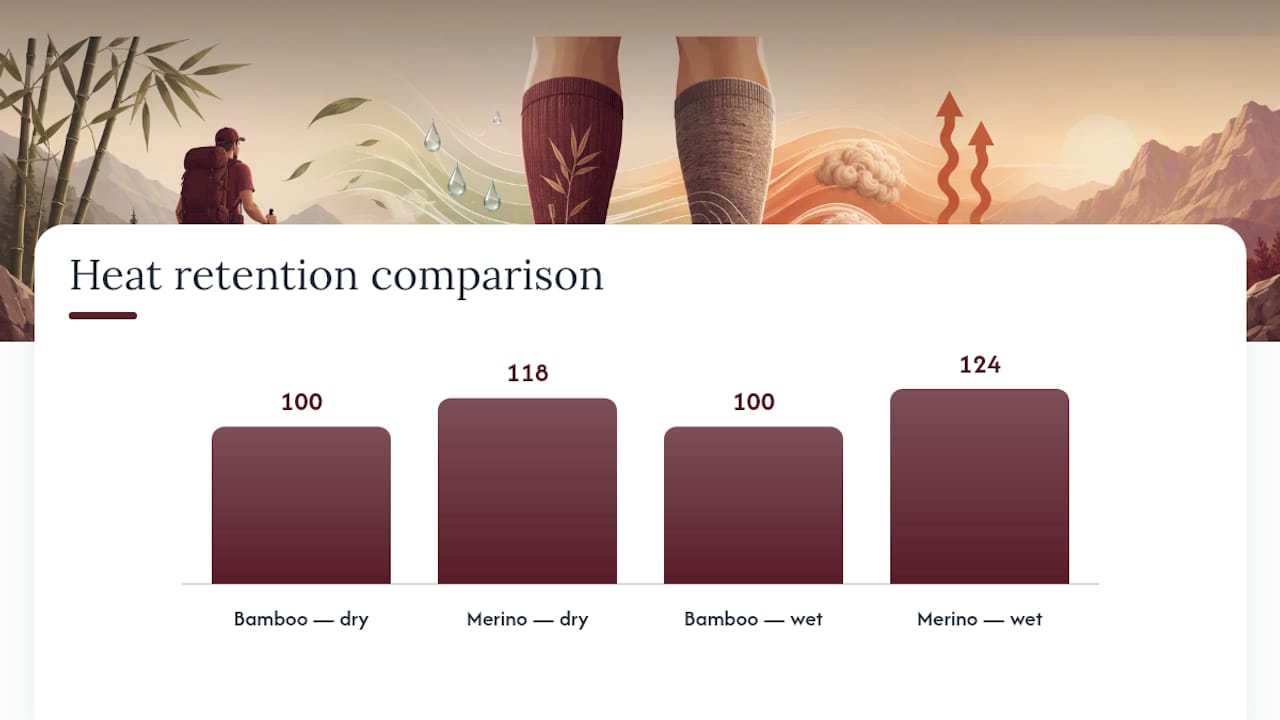
- Merino retains more heat than bamboo — roughly 18% more when dry and about 24% more when wet — so it's the better choice in cold or rainy weather.
- Merino's internal moisture absorption gives it better odor control over long wear, while bamboo wicks moisture on the surface for a fresher initial feel.
- Blended fibers (especially merino or bamboo with nylon and elastane) generally last longer than pure versions of either.
- For wider calves, a stretch bamboo blend designed for larger legs matters more than the fiber debate — look for sizes that actually cover your calf, up to 25 inches.
- Washing in cold water, skipping fabric softener, and air-drying flat extends the life of both bamboo and merino socks.
Table of Contents
- Bamboo vs Merino Socks: What Each Fiber Actually Is
- Which Fiber Feels Softer Against Sensitive Skin?
- How Do Bamboo and Merino Handle Sweat and Odor?
- Which Fiber Keeps You Warmer, Dry or Wet?
- How Long Do Bamboo and Merino Socks Actually Last?
- How Should You Wash Bamboo and Merino Socks?
- Which Fiber Is More Sustainable to Buy?
- What Should You Actually Pay for Bamboo or Merino Socks?
- A Bamboo Option Built Specifically for Wider Calves
- What I Learned Comparing These Socks Side by Side
- Try Bamboo Socks Built for Your Actual Calf Size
- Sources
Bamboo vs Merino Socks: What Each Fiber Actually Is
The bamboo vs merino debate starts with a manufacturing detail most shoppers skip: bamboo socks aren't made from bamboo the way you picture it. Raw bamboo stalk is woody and stiff. To turn it into something wearable, manufacturers dissolve the pulp with solvents and extrude it into fiber, a process that produces bamboo viscose (sometimes labeled bamboo rayon). That's what gives bamboo socks their signature silky drape, but it also strips away much of the antimicrobial character people associate with raw bamboo, according to a comparison from Kingston Grange.
Merino wool works differently because nothing gets dissolved. The fiber comes straight off merino sheep, and its natural structure — a moisture-absorbing core wrapped in a moisture-resistant outer layer — is what gives merino its performance edge.
Neither fiber shows up in socks at 100% very often. Brands blend for a reason:
- Nylon adds strength that pure viscose or wool can't match on its own.
- Elastane (spandex) gives socks the stretch to hold shape around the ankle and calf without sagging.
- Typical bamboo blends run around 60% bamboo viscose, 35% nylon, and 5% elastane.
- Merino blends often mix 60 to 80% wool with nylon and a touch of elastane.
Read the label before you read the marketing copy. A sock advertised as “bamboo” that's actually 25% bamboo and 70% polyester won't behave like the fiber science above.
Which Fiber Feels Softer Against Sensitive Skin?
Softness is subjective, but it's not random. Merino's feel comes down to micron count — the diameter of each fiber. Finer merino (17 to 19 microns) feels noticeably softer than coarser wool, which is why “merino” on a label doesn't guarantee a plush sock. Cheaper merino blends can feel scratchy to people with sensitive skin.
Bamboo viscose skips that variability. Because it's a manufactured fiber, bamboo socks tend to have a consistent, silky feel straight out of the package, with no break-in period. That's a real advantage for anyone with sensitive skin, and it's part of why bamboo shows up so often in socks made for it.
Pro Tip: If a compression sock feels tight enough to dig in within the first hour, the problem usually isn't the fiber — it's the knit's stretch. Look for socks built with extra-stretch panels for wider calves rather than sizing up in a standard sock, which often just makes the foot too loose while the calf still digs in.
Movira's super-stretch bamboo fabric is built around that exact problem, sized to fit calves up to 25 inches without the standard mid-calf squeeze that sends so many women hunting for a bigger size that never quite works.
How Do Bamboo and Merino Handle Sweat and Odor?
Merino wins on odor control, and the mechanism explains why. Merino pulls moisture into its core while keeping the outer layer water-resistant, so sweat gets absorbed into the fiber rather than sitting on the surface where bacteria feed on it. That's why merino has a reputation for staying fresh through several days of travel, an edge confirmed across comfort and odor trials from Woolmark.
Bamboo takes a different approach. It wicks moisture along the surface rather than absorbing it, which makes it feel dry to the touch faster in the short term. The trade-off: over a full day, that surface moisture can let odor build a little sooner.
What that means over a day:
- Heavy sweaters get more consistent odor control from merino, especially past hour six.
- Bamboo's dry-to-the-touch feel shows up fastest in the first hour or two — nice for errands and warm days.
- Frequent travelers packing light benefit from merino's ability to go two or three wears before feeling used.
If your priority is a quick cooling feel on a warm day, bamboo delivers that instantly. If it's packing fewer pairs for a trip, merino is the better bet.
Which Fiber Keeps You Warmer, Dry or Wet?
Merino insulates better in both conditions, and the gap widens once things get wet — roughly 18% more heat retained when dry, about 24% more when wet. Merino can absorb over 30% of its weight in moisture before it feels damp, so it keeps you warm even when soaked. Bamboo has no comparable internal reservoir, so once it's saturated, it cools off fast.
That's not a knock on bamboo — it's a different goal. A fiber that sheds heat quickly is exactly what you want on a warm day when staying cool matters more than staying warm.
- Cold or wet weather: merino, given how it holds up when damp.
- Warm-weather everyday wear: bamboo's cooling feel works in your favor.
- All-day wear or long shifts on your feet: a blend often balances cooling and comfort best.
How Long Do Bamboo and Merino Socks Actually Last?
Merino tends to outlast bamboo under repeated wear, and the reasons are mechanical. Wool fiber flexes and recovers thousands of times without breaking down. Bamboo viscose, a regenerated cellulose fiber, fatigues a little faster, especially at the heel and ball of the foot. That's exactly why blends exist — the nylon carries most of the durability.
- High-percentage merino, rotated regularly: often 1 to 2 years before thinning at the heel.
- Bamboo blends with nylon reinforcement: commonly 6 to 12 months of daily use before the stretch fades.
- Occasional wear (weekends, travel): either fiber can stretch past 2 years with proper care.
How Should You Wash Bamboo and Merino Socks?
Care habits matter almost as much as fiber choice. Rotating a few pairs, washing on the right cycle, and skipping fabric softener are the three habits that extend lifespan most.
- Turn socks inside out before washing to protect the outer surface.
- Wash merino in cold or lukewarm water on a gentle cycle; hot water causes shrinkage.
- Wash bamboo blends in cold water on a gentle cycle.
- Skip fabric softener. It coats fibers and blocks the moisture-wicking you bought the sock for.
- Air-dry flat. High heat breaks down elastane, which is what makes a compression sock lose its grip over time.
Pro Tip: Lay compression socks flat to dry rather than hanging them by the toe. Hanging stretches the fabric downward and can loosen the graduated compression exactly where you need it.
Which Fiber Is More Sustainable to Buy?
Neither fiber is a clean environmental win, and honest sustainability means acknowledging the trade-offs on both sides. Bamboo viscose processing uses solvents that, if not managed well, involve real water use and runoff — even though the plant itself grows fast with little water. Merino comes with concerns around land use and animal welfare, and its footprint varies a lot by farm.
What's worth checking before you buy:
- Look for Woolmark certification on merino, backed by IWTO's guidelines.
- Look for responsibly sourced viscose language on bamboo.
- Treat “eco-friendly” as marketing, not a guarantee, unless there's a specific certification named.
- Consider longevity. A sock that lasts twice as long halves its footprint per wear.
What Should You Actually Pay for Bamboo or Merino Socks?
Bamboo socks typically retail between $8 and $18 a pair, with premium blends reaching $20 to $25. Merino usually runs $25 to $35 for performance-grade pairs. Blends land in between. Once you factor in how long each lasts, the cost-per-wear is often closer than the sticker price suggests, so comfort and fit — not just price — should drive the decision.
| Your priority | Best fiber choice |
|---|---|
| Odor control across multiple wears | Merino |
| Immediate cooling and soft feel | Bamboo |
| Long-term durability under heavy use | Merino or a reinforced blend |
| Lowest upfront cost | Bamboo |
| Wide-calf fit without digging or rolling | Stretch bamboo blend designed for wide calves |
If you're shopping specifically for compression or wide-calf needs, the checklist is short: confirm the sizing chart actually covers your calf circumference (not just shoe size), check whether the compression level is stated in mmHg, and look for a fit guarantee. That last point matters more for wide-calf shoppers than almost anyone, since so many standard compression socks are sized without wider calves in mind.
A Bamboo Option Built Specifically for Wider Calves
Most of the comparison above assumes you can already find a sock that fits your leg. For a lot of women with wider calves, that's the part that breaks down long before fiber choice enters the picture. Standard compression socks are cut for a narrower calf range, so they either dig in hard enough to leave marks or roll down within an hour.
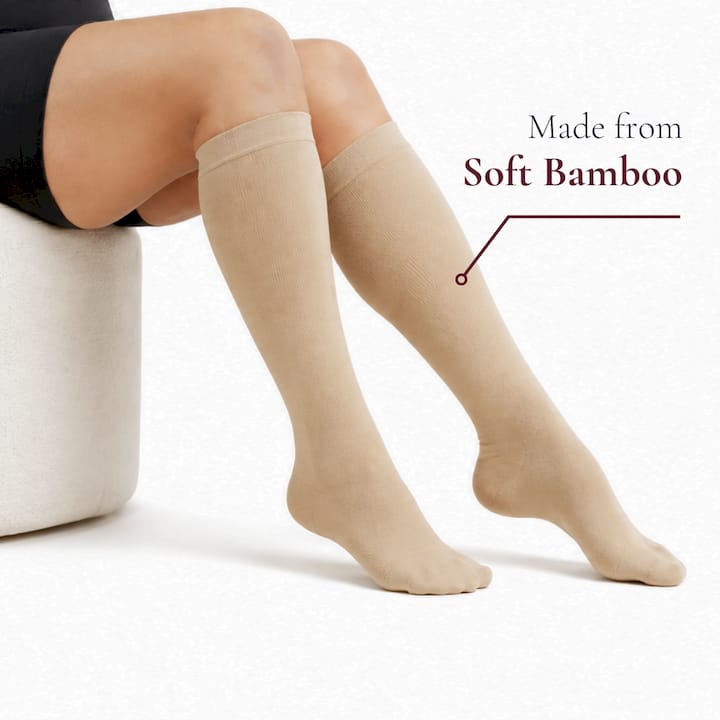
Movira's bamboo wide-calf compression socks were built around that specific problem. The super-stretch bamboo fabric is cut for calves up to 25 inches, sized L through 4XL, with gentle 15 to 20 mmHg graduated compression that feels supportive without looking or feeling medical.
- Sizing runs L to 4XL, a range most standard compression lines skip.
- The stretch fabric moves with the calf instead of creating a fixed band that digs in at one spot.
- Bamboo's breathable, moisture-wicking feel means all-day wear doesn't mean all-day sweat.
- A 60-day fit guarantee backs the sizing, which matters most for buyers who've been burned before.
Pro Tip: If you've measured your calf and you're right between two sizes, size up. A sock that's slightly loose still supports comfortably; one that's too tight isn't pleasant to wear all day.
What I Learned Comparing These Socks Side by Side
The biggest surprise wasn't which fiber “won.” It's how much the marketing around both oversells what the raw material does on its own. Bamboo's antimicrobial reputation mostly fades once you understand what viscose processing does. Merino's premium price makes most sense for heavy, all-day-outdoor use.
Most people buying socks for a daily commute or an office job don't need either fiber's headline feature. They need a sock that fits, doesn't slide down, and doesn't need babying in the laundry. That's a fit and construction question as much as a fiber question — and it's the piece most comparison guides skip.
Try Bamboo Socks Built for Your Actual Calf Size
If everything above points you toward bamboo, but every pair you've tried has dug in, rolled down, or just didn't come in your size, that's a fit problem no fiber comparison can fix on its own. Movira's wide-calf compression socks are built with super-stretch bamboo fabric sized specifically for calves up to 25 inches, from L through 4XL, so the fit gets solved before you even get to comparing wicking or softness.
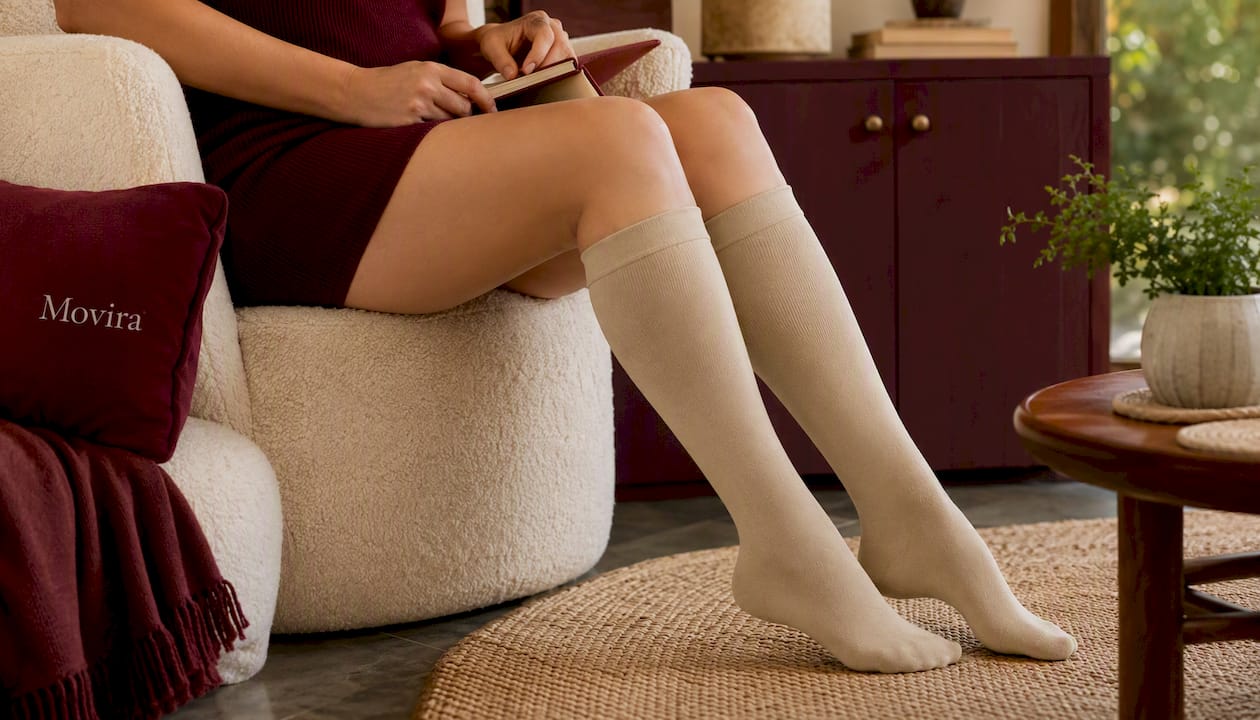
Movira's 60-day fit guarantee lets you try your size and exchange if it isn't right — a lower-risk way to see whether bamboo works for you than guessing through a standard size chart again. Check your calf measurement against the sizing details on the product page and order the size that matches your leg, not just your shoe size.
Sources
- The best merino wool socks — Woolmark
- Bamboo Viscose vs. Merino Wool: Field test — The Hiking Tribe
- The benefits of bamboo socks — Kingston Grange
Recommended
Tags:
Related articles
Plus Size Compression Socks for Women That Fit
Oct 09 2026