

Stop Sock Marks on Legs in a Day for Wide Calf Women Up to 25 Inches
Sock marks on legs almost always come down to one thing: the cuff is narrower than your calf needs it to be. Fix that with three moves and the marks stop. Measure your calf and ankle before you buy, choose a soft bamboo sock with a wide non-binding cuff built for wider calves, and put it on using a smoothing technique instead of a rough tug. Do those three things and the deep grooves disappear within a day.
TL;DR:
- Choosing a wide-calf sock with a non-binding cuff and measuring your calf in the morning helps prevent deep indentations caused by narrow bands.
- Wrinkles or bunching in the sock fabric increase pressure points and worsen marks, so smoothing the sock during donning is essential.
- Materials like bamboo yarn improve moisture management and comfort, making the sock less likely to leave marks after prolonged wear.
- Proper sizing involves matching your calf measurement to the size chart and sizing up if between options, to avoid excessive tightness.
- Regularly replacing worn socks, ideally every few months, maintains elastic support and prevents the elastic from causing persistent leg marks.
Table of Contents
- Why Do Socks Leave Marks on Legs?
- How to Measure Your Calf and Ankle for the Right Fit
- How to Put On Socks Without Digging In
- What to Look for in a Sock That Won’t Dig In
- How to Care for Your Socks So They Stop Digging In Over Time
- Movira’s Take on Why Fit Design Matters More Than Marketing
- Try Movira™ Bamboo Wide Calf Compression Socks
- Sources
- FAQ
Why Do Socks Leave Marks on Legs?
A sock cuff is basically a rubber band wrapped around your leg. When that band is sized for a narrower calf than yours, all the stretch gets used up just getting the fabric over your leg, leaving almost none to spare. The result is a band of concentrated pressure sitting in one spot for hours, which is exactly what leaves those deep sock indentations on legs by the end of the day.
It gets worse when the sock bunches. Wrinkles and folds act like tiny ridges, each one adding its own pressure point on top of the cuff’s baseline squeeze. Rolling the top down to keep it from sliding is one of the most common habits behind this, and it’s also one of the worst. A rolled cuff doubles the fabric on itself, which raises the pressure at that single band even further.
Here’s how to tell if it’s a fit problem or nothing to worry about:
- Faint, temporary marks that fade within a few minutes of removing the sock are typical of graduated compression, which is naturally tightest at the ankle and eases up the leg.
- Deep grooves that linger for 20 minutes or longer, or leave the skin red or indented, usually mean the cuff is too tight for your calf.
- A visible line with puffiness above it by evening is a sign the sock is working against your calf shape rather than with it.
How to Measure Your Calf and Ankle for the Right Fit
Getting this step right solves most sock-mark complaints before you even open the packaging. Measure in the morning, before the day’s activity causes any natural swelling, so you get a true baseline instead of an inflated one.
- Wrap a soft tape measure around the widest part of your calf, usually a few inches below the knee, and note the number in inches.
- Measure your ankle at its narrowest point, just above the ankle bone, since a wide-calf sock still needs to stay snug lower down.
- Measure leg length from your heel to just below the knee if you’re buying a knee-high style, so the cuff lands in the right spot instead of pressing into muscle.
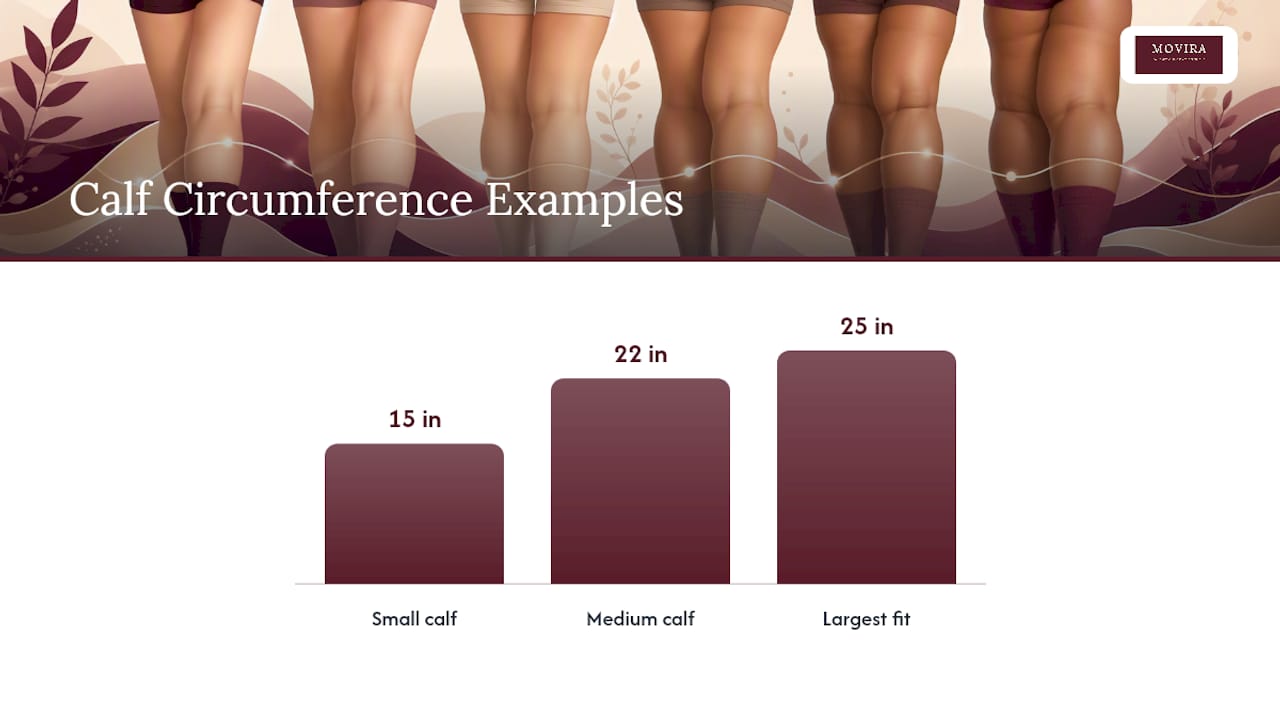
- Match your calf number to the size chart, not your shoe size or your dress size. A 22-inch calf and a 15-inch calf can wear the same shoe size and need completely different sock sizes.
- When you’re between two sizes, size up. A slightly looser cuff that stays comfortable all day beats a snug one that digs in by lunchtime.
Movira’s wide-calf compression socks run L through 4XL and fit calves up to 25 inches, so most women land comfortably inside the range without stacking sizes or hunting for specialty stock.
Pro Tip: If you’ve ever bought a sock that fit at the shop and dug in by the afternoon, measure again after a full day on your feet. Comparing your morning and evening numbers tells you how much wiggle room to build into your size choice.
If a pair still isn’t sitting right once it arrives, that’s what a 60-day fit guarantee is for. Try it, live in it for a couple of weeks, and exchange it if the fit isn’t right, rather than assuming you have to make peace with marks.
How to Put On Socks Without Digging In
Even the right size can leave marks if it goes on wrong. The fabric has to end up smooth against your skin, with no folds acting as extra pressure bands.
- Turn the sock inside out down to the heel so you’re working with a small, manageable pocket of fabric rather than the full tube.
- Slip your foot in and align the heel with the sock’s built-in heel pocket before pulling anything higher.
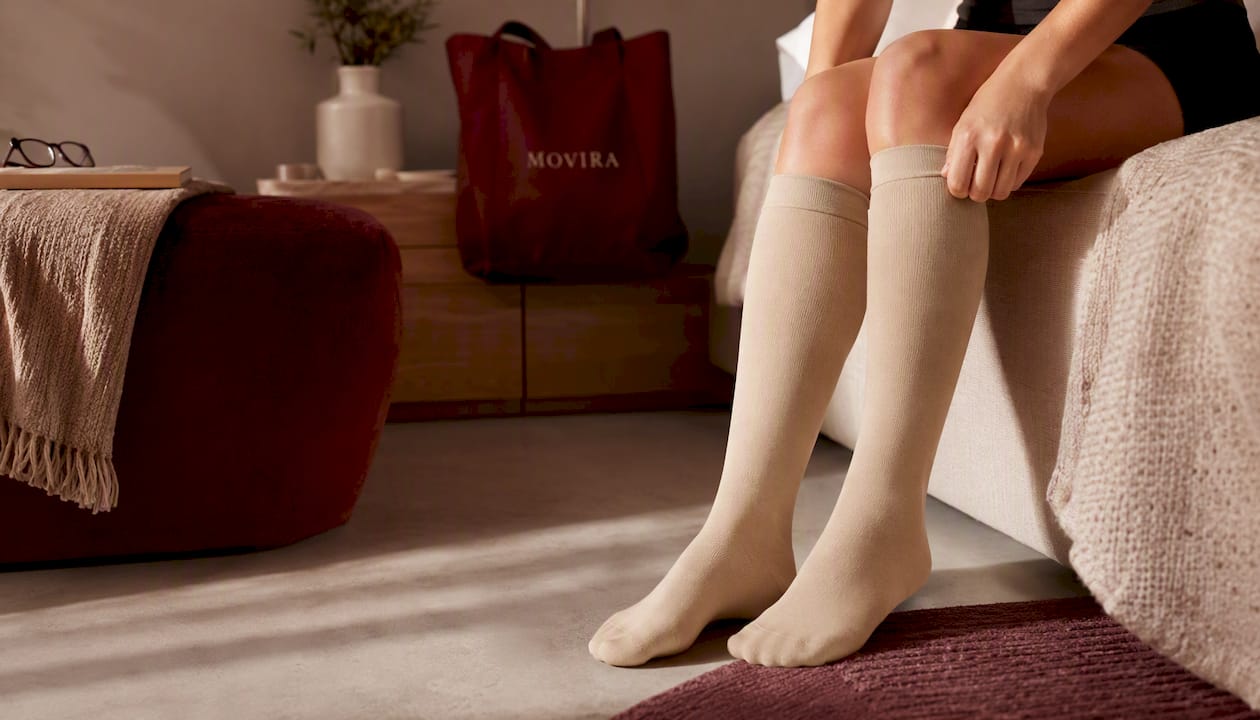
- Unroll the fabric upward in sections, smoothing each part flat against your calf as you go rather than yanking the top edge all the way up in one motion.
Smoothing beats pulling because a hard tug drags fabric unevenly and traps wrinkles behind it, right where you can’t see them. And whatever you do, resist folding the top band down to make it feel more secure. A doubled-over cuff acts almost like a second, tighter sock stacked over the first, and that’s a fast way to turn a comfortable pair into ones that leave marks.
Once it’s on, run a quick check: no visible wrinkles, even tension from ankle to knee, and a cuff that lies flat rather than curling. If all three check out, you’re set for the day.
What to Look for in a Sock That Won’t Dig In
Fit gets you most of the way there, but the materials and construction do the rest of the work. A few features separate a sock that disappears on your leg from one you’re peeling off by 3 p.m.
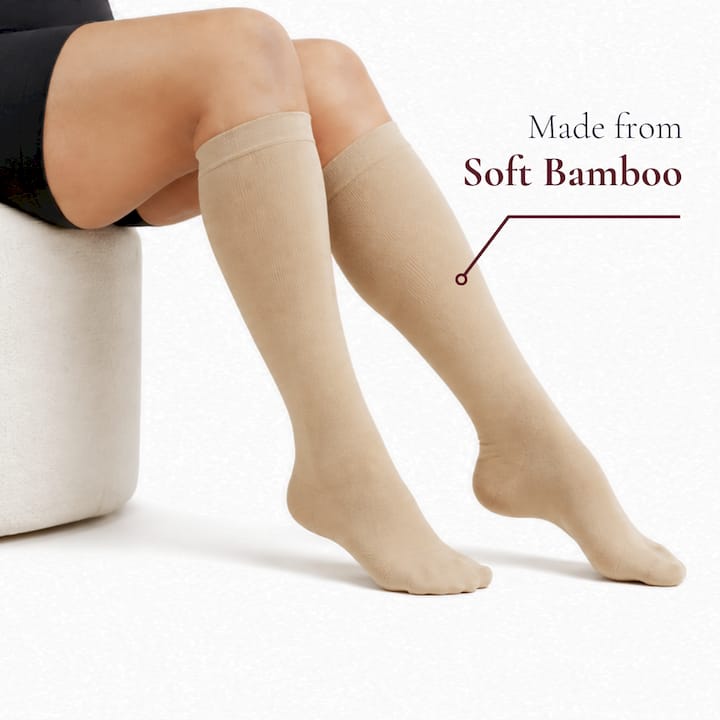
- Bamboo fabric. Lab comparisons of sock materials found bamboo yarn knitwear outperforms several conventional fibers on moisture absorption and ventilation, which is a big part of why it feels cooler and softer against skin during long wear.
- A wide, non-binding cuff. Look for a turn-welt top or a flat band designed to spread pressure across a wider zone instead of concentrating it in a thin strip.
- Super-stretch construction. Fabric with generous give lets the sock expand to your calf shape rather than forcing your calf to compress to the sock’s shape.
- Seamless toes. A flat-knit toe seam avoids one more pressure point on skin that’s already working hard to stay comfortable through a full day.
On compression level: many everyday comfort socks fall in the 15 to 20 mmHg range, which most healthy adults find supportive without feeling restrictive. That’s a comfort spec, not a medical one, and it’s worth choosing based on how your legs feel rather than chasing a higher number.
Interestingly, a study across a full range of commercial compression garment sizes found that larger sizes sometimes register lower measured pressure than smaller sizes in the same product line, not higher. That’s the opposite of what most people assume, and it’s exactly why sizing by circumference and choosing a design built specifically for wider calves matters more than just buying a bigger version of a small sock.
How to Care for Your Socks So They Stop Digging In Over Time
A sock that fit perfectly on day one can start leaving marks months later, and it’s usually not your calves that changed. It’s the elastic.
- Wash inside out on a gentle cycle to protect the fibers that give the cuff its stretch.
- Skip the high-heat dryer and air dry instead. Repeated machine drying and harsh detergents wear down elasticity faster than almost anything else.
- Watch for sagging or uneven tension. If a cuff that used to sit snug now slides down, or one spot feels tighter than the rest, the elastic has started to fatigue.
- Plan on replacing well-worn pairs every few months if you wear them daily. Think of it as a small, predictable cost rather than a surprise, so you’re never stuck wearing a pair that’s lost its shape and started digging in again.
Movira’s Take on Why Fit Design Matters More Than Marketing
Most compression socks are designed around an average calf, then stretched to fit everyone above that. That approach is backwards. A cuff that has to work overtime to cover a wider calf is a cuff under constant strain, and constant strain is what leaves marks.
Movira built its socks the other way around: sizes L through 4XL, cuffs engineered for calves up to 25 inches, with super-stretch bamboo doing the work instead of raw elastic tension. Pair that with the measurement steps above and the right size stops being a guess. If a pair still digs in after you’ve measured and donned it correctly, the 60-day fit guarantee means you’re never stuck living with it.
— Movira Team
Try Movira™ Bamboo Wide Calf Compression Socks
You’ve already done the hard part: you know how to measure, how to put a sock on without bunching it, and what features actually prevent digging. The next step is simple. Movira’s bamboo wide-calf compression socks come in sizes L through 4XL, fit calves up to 25 inches, and use a soft, non-binding cuff with 15 to 20 mmHg graduated support built for comfort, not medical use.
Grab your calf measurement from the checklist above, then browse the wide-calf compression sock collection to match your number to a size. If anything about the fit isn’t right once you’ve worn them, the 60-day fit guarantee gives you room to exchange or return them, no pressure and no guesswork.
Sources
- Physical properties and pressure variation across sizes of commercial GCS (UDel repository)
- What you should know about compression socks (Cleveland Clinic)
- Thermo‑physiological properties of socks made from different fibers (DOI)
FAQ
Why do my socks leave marks on my legs?
The cuff is usually narrower than your calf needs, which concentrates pressure into one thin band instead of spreading it evenly. Rolling the top down or wearing a wrinkled sock makes it worse.
Are sock indentations on legs always a sign of a bad fit?
Not always. Faint marks that fade within minutes are normal with graduated compression, but deep grooves that linger usually mean the sock is too tight or the wrong size.
Do compression socks help calf pain from tight-fitting socks?
A properly fitted compression sock with a wide, non-binding cuff is designed for even pressure and all-day comfort rather than the pinching that causes calf discomfort in the first place.
What size should I get if my calf measures close to 25 inches?
Measure your calf at its widest point in the morning and match that number to the size chart. Movira’s socks run L through 4XL and are built to fit calves up to 25 inches without a snug or digging cuff.
How often should I replace compression socks to avoid digging in?
Once you notice sagging, uneven tension, or marks that didn’t used to happen, the elastic has likely worn out. Daily wearers typically need to replace socks every few months to keep the fit consistent.
Recommended
- 5 Reasons Why Women Are Switching to these Compression Socks
- Movira Bamboo Wide-Calf Compression Socks | L–4XL
- Personal Story / Comparison
- Tried Every Compression Sock
This article is for general information and fit/comfort guidance only. It is not medical advice. Movira socks are everyday comfort products, not a medical or prescription device.
Tags:
Previous
2–4 Years vs a Decade: Bamboo Viscose vs Cotton for Sensitive Skin
Next
Wide Calves: Stop Compression Socks From Digging In (Fits up to 25")
Related articles
Compression Leggings vs Socks: What to Wear
Nov 20 2026
Zipper Compression Socks Problems: What to Know
Nov 20 2026

Compression Levels Explained for Everyday Wear
Nov 20 2026

Graduated Compression for Wide Calves: Daily Use
Nov 17 2026

Tight Socks? How to Find a Comfortable Fit
Nov 17 2026
Light Compression Socks for Women: When to Wear
Nov 15 2026

Knee High Socks for Wide Calves: How to Choose
Nov 14 2026
Wide Calf Compression Guide: Find Your Fit
Nov 13 2026